We often talk about how we can’t unsee something. Whether an assassination on TV, a bomb being dropped, or a predator attacking its prey, it sticks with us when we see something horrific. But what about how we see? That matters because whatever we actually see we see through the filter of our mhat tells us how to interpret what we are seeing. It tells us what to pay attention to, what to ignore, what to believe, what not to believe. It tells us what is good, what is evil, what is dangerous, what is safe.
There is a common theme in much of Christianity and that is seeing things through the ‘Christian world view’. It is how they see the world and how they think the world should be seen. If people saw the world that way, the correct way according to them, then the world would be a better place. It is a filter through which they interpret the world. All religions do the same as do political and social movements. We all have a point of view and I don’t see that as wrong, up to a point.
That point where I think it goes wrong is when all other world views are either ignored, ridiculed, condemned, hated, or dismissed. This usually happens not because those other world views deserve it but because the person doing the seeing is afraid or ignorant of those other world views.
What would happen if you weren’t afraid of others ways of seeing the world? What if you allowed yourself to see through those other filters? Would you become one of those people? Would you suddenly convert or abandon how you see the world? Evidence shows that is not the case. Just because you listen to someone, even someone with good arguments, does not mean you are required to overhaul your belief systems.
What most people who are open to ‘seeing’ other views actually do is understand better. I think that is a good thing.
Violence is a Confession of Ultimate Inarticulateness
It doesn’t matter if you agreed or disagreed vehemently with Charlie Kirk. You had the opportunity to debate and argue with him, or anyone else, about those issues, or about methods, character, truth, God or any other subject.
That was what he was doing when he was murdered – debating and arguing.
If you can’t or won’t educate yourself enough to do that, then the fault is yours, not his.
The same goes for ANYONE else you disagree with right, left, or center.
You don’t have the right to take your inability, that intellectual or emotional impotence, and murder someone because of it, no matter what absurd rationalization you cover it with.
Her eyes were closed during the sermon and I was worried about her coffee on the ledge so I decided she was worried about it too.
The Sermon About Money
I imagined her speaking one and thinking another.
The Sermon About Barabbas
The young women listening closely to the guest pastor preaching about Barabbas being set free instead of Jesus on the order of Pilate who washed his hands of the whole thing and went home to a good dinner.
Uh Uh Uh
Um
Um Ahh Hmm
The doctor studied the patient and diagnosed she was a snake and prescribed and apple a day
Most of my collages end up being in series, but not all. Just as with the horizontal collages I posted prior to this one, many times I am not focused on a theme, I’m focused on a person. In each of these cases I met these people serendipitously. While some of the people I knew before hand, there were no planned shoots, no advanced warning. I saw them, (in some cases just meeting them for the first time), asked them to let me photograph them at that moment and they said yes. That was it. They and the environment they were in gave me the raw material and I built the collages from there.
The Texture of the Truth
I was looking for an estate sale in a neighborhood and happened upon an open house on the same block. I went in just out of curiosity and met the realtor. When I finished looking around I found her out on the front porch. She was lit beautifully with front light and since I had my camera with me I took a chance and asked her if I could take some photographs of her right there and then. She said yes. The clarity, texture and contrast of her skin was perfect, especially her hand against her teal colored shirt.
The Circles Around Her
I was at an art opening in Downtown Tulsa when I happened upon one of my daughter’s closest high school friends from many years before. I first saw someone lit from behind by the circles of a giant interactive Light Bright and took a quick picture. It wasn’t until I came up closer that I realized it was her. She had seen plenty of my artwork in our home over the years so she knew exactly what I did. She was game for me to take some quick pics of her in the middle of this outdoor art scene.
The Natural Function
I was at a coffee house in Tulsa when I noticed a high school friend of one of my daughters from years before sitting at a nearby table working. I eventually went up to her to say hi and noticed she was doing math homework. She had the late afternoon sun hitting her at that point and the color was amazing. I asked her if I could take some photographs of her and her surroundings and she said yes.
The Mind and Heart
I met this woman at a cafe in Tulsa. She had on some gorgeous jewelry that caught my eye. I introduced myself and had a nice conversation about many things including the jewelry, which was of her own creation. I asked if I could take some photographs of her and the jewelry and she said yes. We also talked about using both your head and heart to create and when I went outside I found a very colorful pile of trash inexplicably on the side of the road and a single cloud all by itself in the sky. They seems a metaphor for the head and heart so I put them in the middle of her portrait.
The Jewelry Truth
This woman was a student at the medical college where I worked and I would see her again and again with incredible jewelry. Finally I asked her if I could take some photographs of her and her jewels for a collage. They seemed to be so much of an organic part of her that I wanted them coming directly out of her.
Pretty Angst
I met this woman at an art opening in Tulsa. I was single at the time and we made plans to get together. We did a number of art oriented things together though we never actually dated. She ended up posing for me 2-3 times for collages. She had a complicated and convoluted life situation at the time and this collage was meant to express that fragmentation.
What Surrounded Her Smile
I was in Shenendoah Valley, Virginia for a wedding and visited a medicinal herb shop. The proprietor explained some of the items for sale with such a positive, smiling attitude that I really wanted to do a collage of her and all that surrounded her. And so I did.
Boat Gabardine
She was a co-worker of mine. When I photographed her she told me her dress fabric pattern was called Gabardine. I made a collage of a photo of the fabric/skin and it reminded me of a boat.
Relative Construction
It started out as a portrait of a relative of mine and it still is but sometimes a portrait becomes abstract and it’s all about the formal elements of color, texture, contrast and composition, not a face or a body.
Portrait in a Garden
I was in Colorado for a wedding when I met this woman in the lobby of the hotel we were staying at. She asked about my camera and that led to me telling her about my photography and photo collages. Next thing I know I am in the garden next to the hotel taking photographs of her and her surroundings. In particular I loved finding leaves in the garden that echoed the texture of the skin on her chest.
The Beauty Blend
I met this mother daughter duo at a wedding. The more I looked at them the more I saw how, even though they dressed and styled themselves differently, they still retained a strong connection. I asked them if I could take some photographs for a collage and they said yes.
The Good Dream
For many years I worked at a restaurant in San Jose, California. One co-worker was a music student at the time and later became a professional singer. She posed for me in an opera gown for a large drawing I was doing at the time (early 1990s). Years later I met up with her in Boston where she was performing at the big central church of her denomination. I was able to go to the service and hear her. Afterwards I took some photos of her, the sanctuary, church and details that I later used for this collage.
While many of my photo collages are done in series, not all are. Often I am doing a portrait collage and it’s not connected to a theme, it’s connected to an individual. Such is the case with these.
Many of them were strangers that I happened to meet at work or at events. Something about them caught my eye. I explained that I was an artist doing photo-collages and asked if I could take photos of them. They said yes and these are the results.
The Bride To Be
She worked with me and I was taken by the decor in her office. I asked if I could take some photos of her in that environment and while I was taking the photos she said she was about to get married.
The Coleman Daughters
The photos of our daughters, Rebekah, Chelsea, Caitlin and Connie were taken at our wedding on November 11th, 2006.
Winter Portrait With Joy
I came out of work one winter day and saw this woman slipping and sliding away on the ice covered slope next to the parking lot. She was all alone having fun. I watched her for a while the asked her if I could take some photos of her in action. She agreed and continued to slide for a while. She later came over and allowed me to take some portraits so I could make a collage.
Wave of Diamonds
A Student at the University where I worked.
Nature/Nurture
A student at the University where I worked.
Nails
Someone I was related to or knew, I forget who, was getting a manicure. I took pics of her nails being done and then asked the nail technician if I could take photographs of her to create a collage.
Journey to the Interior
I took the photos of my step-daughter Caitlin on our trip to Virginia for my daughter Rebekah’s wedding in 2006.
Hair and Scar
She was sitting in the row right in front of me at some event and was playing with her hair. I was mesmerized by that alone and then she parted her hair at one point to expose the scar. I asked her if I could take photos and she said yes.
Rococo
A student at the University where I worked.
The Vortex She Creates
I was hired to take some ‘boudoir’ style photos of this woman and while doing so found many opportunities to get photos that exposed a more revealing version of her than one without clothes.
Surfaces of the Interior
She was at a coffee shop I was at and I was taken by the lightness of her blue eyes. I felt if I could capture that light I would find a way into her interior. I asked her if I could take some photographs and she said yes.
Back in 2015 LInda, Caitlin and I took a vacation to London and Paris. I did many pen and ink drawings in my sketchbook. I didn’t paint any of them at the time but always had the intention of getting back to them to do that. When I got home from my 2025 trip to Europe I took out my old 2015 sketchbook to compare drawings from the two adventures and decided it was time to paint.
I chose to only partially paint the drawings as an experiment. I like them this way. what do you think?
The Bird’s Nest, 2015-2025
She did everything fast, frenetic, like a bird. She built her nest in the seat next to mine as we flew over the Atlantic.
The Shot of Coffee, 2015-2025
She wasn’t sure what I meant when I said I wanted a shot of coffee but it was my fault while in London because I didn’t know but the tall guy told me that they call it filtered coffee and then she knew.
The Love Far Away, 2015-2025
She ate her oatmeal as she thought of the love of her life far away but happy.
The Arm Drawn Wrong, 2015-2025
She had crutches and was eating a paster and I drew her arm wrong and had to make up for it as best I could.
Self-Portrait, 2015-2025
Self-portrait in an iPad while I Periscope in a coffee shop, Il Molino, in Lavender Hill in London, UK and eating pastries.
The Lovers, 2015-2025
I didn’t meet them so I made up a story about them but it isn’t true so I will tell it to you now. They were lovers breaking up in a french cafe but were from Rome and one wanted to go home and the other pretended to care but had a secret.
The Museum I Didn’t Go To, 2015-2025
The woman looked so French with her big bow and loose bobbed hair that I had to draw her but it was the woman eating in the back who noticed me drawing and came over wanted to see and told me about her favorite museum that I didn’t end up going to.
Caitlin and the Shy Asian Girl, 2015-2025
Caitlin didn’t know I was drawing her but the shy asian girl with the stylish hat did and it made her smile and blush and happy and I gave her my card.
She Wished She Stayed, 2015-2025
She was in Paris and was bringing home gifts to her family but wished she could stay because the kind man in the train station who saved her from having her wallet stolen and they had talked and he walked her and her friend over to the cute cafe for a glass of wine and they talked more and he helped them find the store selling a certain type of Macarons and then to dinner where they ate escargot and drank more wine and she thought she was too old for that sort of thing but felt the tingle and was happy.
I studied Art History a lot in undergraduate and graduate school. I learned all the isms, all the movements and all the major participants. But some people never fit into a movement or an ism. Sometimes I liked their work anyway, other times they didn’t do much for me and they fell by the wayside. Marisol was in that group. She did blocky wooden sculptures of people that for some reason just didn’t engender any curiosity for me. I never knew more than just her greatest hits that would be in art history books or magazines and even those I perused with indifference.
But when there was going to be a major retrospective of her work at the Dallas Museum of Art I felt there was no reason for me not to check it out. At worst I would have a great day at the museum and among the food trucks next door and create some good sketchbook drawings.
I was more than pleasantly surprised. I found the work of an incredible artist who is profoundly creative, courageous, original and persistent in pursuing her vision. I had no idea of the breadth and depth of her work. This is why I go to exhibitions, because seeing what an art historian writes up in a book about an artist is no different than reading a music review of an album instead of actually listening to the album. One must experience creativity first hand to really feel it.
Here are some highlights from my visit.
Three Women with Umbrella – 1966 –
Three white women elegantly dressed up juxtaposed with a terrified young Vietnamese child holding a teddy bear. The working title for this was simply ‘Vietnam’. It is this type of sly commentary about social and political issues that made Marisol so unique.
Graphite and paint on wood with plexiglas, found plastic umbrella and stuffed bird
Three Women with Umbrella – close up
Three Women with Umbrella – close up
The Jazz Wall – 1963 – wood, found objects, paper and paint on wood
The Jazz Wall – close up
The Jazz Wall – close up
Marisol used her own face for the castings of the trumpet and piano players.
Illustration for Paris Review – 1967 – Ink on paper, Silkscreen – artist’s proof
Doll – various fabrics – 1955-63
Marisol was sometimes trivialized by the press as making toy-like art and dolls. She did make many dolls, often as part of larger sculptures but also as stand alone pieces. Her inspiration stemmed from an older artist in Venezuela, Armando Reverón, who did the same thing.
Baby Boy – 1962-1963 – Painted wood and mixed media
Another covert commentary in guise of a something benign. The baby boy is monstrously big and is seemingly manhandling the doll (with a photo of Marisol’s face). The clothing is a partial white star, a blue sleeve and red stripes. At the time someone paying attention would have understood the messaging that the US is a big toddler bully, only partially aware of the damage it is causing.
Baby Boy – close upSelf-Portrait – 1961-1962 – Wood, plaster, marker, paint, graphite, human teeth, gold and plastic
Self Portrait – close up
Ruth – 1962 – carved wood and mixed media
This is a portrait of Marisol’s good friend Ruth Kligman, a big personality in New York art world of the 50s and 60s who had an affair with Jackson Pollack and was injured in the car wreck that killed him in 1956.
There are multiple portraits in the round with cast hands (Marisol’s) and cast bell peppers as breasts.
Ruth – close up
Tea for Three – 1960 – Wood, acrylic, found objects
This sculpture shows one of the first times Marisol used her own body. The casts of mouth, nose and hands are hers.
The colors represent the Venezuelan flag, her heritage.
Tea for Three – close upThe Party – 1965-1966 – Assemblage of 15 freestanding, life-size figures and three wall panels
The Party, close up
The Party, close up
Marisol was a well-known celebrity in the mid 60s, often found in the pages of fashion magazines alongside her creations as well as at well documented parties among the cognoscenti of the time.. This ambitious piece recreates that world from the most to the least celebrated. Each figure is endowed with the artist’s own face, thus making a statement not just about society but about herself.
Swimming in a New Direction
At the height of her fame in 1968 she disappeared. She took off for points unknown to most of the art world, divorcing herself from that society for a period of time. What she did with that time was to travel and specifically to travel underwater. She learned to scuba dive and spent years taking photos and film underwater. Five years later, in 1973, she started to show the creative results of that exploration.
The large figure looks much like the famous Greek Kouros. Both the odd creature at the fishman’s feet and the fish he is holding have faces that are casts of Marisol’s face.
Pescado – 1970 – cast acrylic – edition of 75
Barracuda – 1971 – wood, varnish, plastic
An interesting side note – All the fish she sculpted were given the names of US warships of the time. She was once again creating art and making political statements, however obliquely, at the same time.
Untitled – 1972 – watercolor and ballpoint pen on paper
St Maarten – 1972 – Gouache, watercolor and graphite on paper
While she was on her travels she painted extensively in her sketchbooks and on larger pieces.
Diptych – 1971 – Lithograph
Marisol also experimented extensively with printmaking. In this instance she was inspired by the Japanese technique of Gyotaku printing, pressing a fish against paper to document prize catches. Instead of fish she used her own oiled and nude body pressed on to two lithography stones that she then worked and printed.
You can see in the close up the cartoon heart pierced by and arrow and the wound in her side surrounded by teeth.
This using of a technique that is used to celebrate catches of meat on her own body instead is a courageous statement of the objectifying sexism of her day.
Diptych – close upi Did My Future – 1974 – colored pencil and graphite on paper
Marisol never shied away from speaking her mind about the abstract violence of war and the very real violence against women and others right around her in New York and beyond.
Here she uses a friend’s body that has been laid out on paper that she then outlines with randomly chosen colored pencils. Combining the blood tinged body outline with dark guns, anonymous sexually grabbing hands and a realistic rendering of the model’s infant child is a great example of the power of artistic creativity to send a profound message.
Horace Poolaw – 1993 – wood, paint, graphite, plaster and metal wheeled base
This was Marisol’s contribution to an exhibition celebrating the 500th anniversary of Columbus’s voyage to the new world.
She created a portrait of an indigenous person set on a police barricade cart that says ‘Police Line Do Not Cross’.
The Funeral – 1996 – Paint, crayon, and oil on wood
Marisol’s social commentary sometimes went into pathos and despair as can be seen in this sculpture of JFK Jr. saluting at his father’s funeral.
Picasso – 1977 – Painted Bronze
Untitled – 2006 – graphite and colored pencil on paper
As Marisol aged she lost her memory but not her ability or desire to create. She did numerous drawings of her caregivers, friends and self-portraits. Her techniques and subject matter remained constant throughout her life even as her materials were reduced to just colored pencils.
Hopefully you come away from seeing this collection with either a new or expanded appreciation for an artist who never wavered in her intense desire for freedom of creativity and an insightful and heartfelt response to what in her mind was a grossly unfair and hurtful world. She did not pursue fame and fortune but rather substance and meaning. In that she succeeded.
After I got home from France I was inspired to continue to create when out and about as much as possible. This includes, as usual, drawing in church. But I also drew on the train, in a park and in a museum. And, as is often the case, I also drew images that I just made up in my head. I also painted a drawing I started while in France.
Mèlanie a Hotel Demeure, Paris
Once I painted the image I made sure to contact Mélanie at the hotel and send her the finished image. She was happy to see it and made a point to welcome us to stay there again if we came back.
TheSinger WaitingDistracted PrayerListening to the Sermon About the TongueLunch at the Kimbell Museum, Fort Worth, TXKatie with the DrawingEating at Klyde Warren Park, Dallas, TXWaiting for Food at Klyde Warren Park, Dallas, TXReading a Book About Women on DARTReading Her Phone on DARTThe Sermon Was About FireThe Butterfly and the VolcanoSpirals
I went to the Pantheon in Paris in the spring of 2025. I had no idea what to expect beyond there were certain famous french people entombed there. What I found was an amazing architectural space with huge paintings depicting the lives of many of France’s most famous founders, saints and martyrs, monumental sculptures depicting moments from French history and the tombs of some of the greats like Rousseau and Voltaire. going solo allowed me to soak in the space, the art and the history without time constraints.
All of it was a new discovery but one element took me completely by surprise and that was an exhibition by Anselm Keifer, the illustrious German artist. I have been aware of his work most of my adult life but had probably only seen one or two of his massive paintings in the flesh.
The exhibition is six large see-through steel and glass boxes known as vitrines in the middle of the Pantheon space. They seem invisible at first since you could see through them and the color scheme throughout the pieces was somewhat muted and not in high contrast to the surroundings. However, once I started to look at them I was mesmerized. He’s known as an artist who taps into history, especially German history of the World War Two era. His images are evocative and hint at the catastrophes of that era.
But these images were not about World War Two, instead they referenced World War One. In many ways, it had an even more profound effect on all of Europe than its successor because the needless and horrendous wasteful slaughter and the profound changes societally and politically that happened as a result. These are the things he was addressing in these images along with memory and hope.
The Women of 14 – The Men of 14 – Anselm Kieffer, 2020
The Women of 14 – The Men of 14 – Anselm Kieffer – detail, 2020
What Are We? – Anselm Kieffer, 2020
What Are We? (detail) – Anselm Kieffer – detail, 2020
Poppies and Memories – Anselm Kieffer, 2020
Poppies and Memories (detail) – Anselm Kieffer – detail, 2020
What I love most about these is because of their transparency in the larger setting of the Pantheon you see not just the powerful and creative WW1 story you also see French history, architecture, and culture within, behind, around and reflected in the image, giving it a much more profound story telling power. They are some of the most effective art pieces I have ever seen.
I like my large sketchbook because the paper is very high quality and takes the ink very well. I got it at the Kimbell Art Museum in Fort Worth, Texas a couple of years back. While in France this one came out most mornings at breakfast and a few other times when I was alone and/or had plenty of time.
En Attente de Voler Vers la France
I loved this scene because of the juxtaposition between partners. One in a tshirt and shorts, the other in a big puffy winter coat. We all do what we need to do when we fly, right?
En Attendant le Train à Grande Vityesse
We had a long layover at Charles de Gaulle Airport before our bullet train to the Loire Valley. This young woman was also waiting so I took the opportunity to draw her. The space was beautiful, all windows, giant beams and guide wires supporting the roof while in the foreground there was a huge plant taking up the entire left side of my field of vision. It made for a very active background and foreground.
Petit-déjeuner à AmboisePetit-dejeuner à VersaillesHommes d’affaires au petit-déjeunerEmployé d’hôtel à Caen
Every morning I got up early and either went for a run or sat and drew during breakfast or in the lobby. Most days there was someone in the restaurant to draw but one morning there was no one so I went into the lounge and drew the hotel employee behind the desk, which also was a coffee bar.
Dejeuner au café ‘Hoct and Loct’ à Paris
My Brother-in-law Steve and I were on our own after returning the rental car so we took a stroll around Paris. We found a great little cafe for lunch and I was thinking I wish I was alone so I could just sit and draw for as long as I wanted when something surprising occurred. Steve brought out a small sketchbook and said, ‘Marty, teach me to draw.’ He had bought a sketchbook and pencils just to take on the trip. So I gave him some pointers, mostly just about not trying to worry about accuracy and not trying to make it look like a photograph and off we went. We probably spent an hour just eating our lunch and drawing and it was a lot of fun! He did really well and it made my day that he made the effort to connect with me in that way on vacation.
Le Pendule de Foucault avec le Monument à Diderot en Arriére-plan
The next day I was on my own in Paris. I was planning to go see the David Hockney exhibition at the Foundation Louis Vuitton but it was sold out so I pivoted to the Pantheon. I wanted all of us to go but I couldn’t convince the others it was worth it so I went solo. It was worth it. An AMAZING space with incredible history, paintings and sculptures. I will post more about it in the future when I continue my ‘Art I Love’ series. While I was there I spent a substantial amount of time doing this drawing. It’s hard to draw a pendulum because it is always moving but besides that it’s pretty much invisible. You have to draw the background to give it some space in which to live. I was able to find a bench facing the monument to Diderot so that became my background so to speak.
While I was drawing I saw a young girl sort of hovering around me. She was obviously watching me draw but was too shy to come up and talk to me. Eventually her mother came alongside her and they moved forward just a bit. I stopped drawing and gestured for them to come over. They were from England and I was able to speak to them. I showed her the drawing, explained to her what I was working on in the drawing and why. I told the young girl she could do the same thing with practice. The mother asked if it was possible to see the other drawing in the sketchbook so I turned a number of pages and showed them the completed drawings from days earlier and some I had done back home. They were very appreciative and left feeling like they had seen a genuine Parisian moment of an artist drawing, even if I wasn’t French!
Melanie à Hôtel Demeure, Paris
The last day we were in Paris there was no one yet in the breakfast area of the hotel so I meandered over to the front desk area and asked the clerk, Melanie, if I could draw her. She was amenable. We had a nice time talking about Paris and I was happy to get one final drawing in before we left for the states.
and this is what it became once I got home and painted it.
On this trip I took two sketchbooks to France, one small, one large.
I brought out the small sketchbook for when I felt like I had just a few moments to draw or I had limited room, like on the airplane. Here are the drawings from that sketchbook with any photos I took of the scene I was drawing.
Small Sketchbook
à l’extérieur du Café du Château, Amboise, France
We flew into Paris but immediately took a train down to the Loire Valley to meet Linda’s sister and brother-in-law. While we waited for our dinner reservations I drew this scene at a nearby café.
Le Paon Blanc au Jardin de Leonardo da Vinci, France
I know this is a pretty pathetic drawing of a peacock but you try drawing a moving bird!
Petit Déjeuner à l’hôtel à Caen
Each morning I tried to get in either a run or a drawing. Our hotels weren’t in urban areas until we were in Paris so I didn’t find little cafes to go and sit at. But each hotel had a breakfast (petit-dejeuner) area so I settled in and drew there.
Concert à Notre Dame
We got tickets to go to a concert in Notre Dame the first evening we were in Paris. It was a selection of sacred music, mostly about Mary, the mother of Jesus. Before it started I drew the scene, including the very large head of a man right in front of me.
Constance en Cour de la Maison de Delacroix
I had a whole day to myself while in Paris. I went to the Pantheon (see the ‘large drawings’ for a drawing I did there) and then to the Delacroix Museum. It is a very small museum located in an apartment he lived in at one point. I thought I was exiting when I discovered I was being led to a beautiful courtyard garden. While I was in the courtyard I noticed a young woman reading. I decided to draw her and luckily she stayed for quite a long time. When I was done I showed the drawing to her and she was very happy about it. It turns out that her name is Constance, which is also the name of one of my daughters. We had a nice conversation about art, books and Paris before I left.
Un Femme de Profil en Paris
As much as Paris is fantastic one thing my wife found was that the tea left something to be desired. So that meant she was very excited to see a Starbucks and went in to get her favorite Matcha tea. I stayed outside and drew this woman who was beside me. She seemed to also be waiting for someone.
Jeune Femme Assise au Mussée du Louvre
Going to the Louvre is always an adventure. So many people, so many ways to get lost in the crowd. I was waiting for my compatriots to come back from the bathrooms and saw this young woman sitting all by herself, deep into her phone with her hair obscuring almost all of her face. I knew I would have to work fast so I did a minimalist portrait that I think captures her perfectly.
Le Coureur Avant la Course en Paris
While up early drinking coffee downstair in the hotel I met a couple from Iowa. They were both dressed as runners so I struck up a conversation with them as they were ready to head out for their first run in Paris. I saw them the next morning as well but both mornings I either didn’t run or ran earlier. It would have been fun to run with them. I drew the woman of the couple as she sat drinking her coffee before the run.
Julie Dans l’avion Pour Londres
We met this woman, Julie, and her family as we were headed home. We had a change over in London and met them at the British Air desk before we checked in. They went on their way and we thought we were about to do the same but there was a hiccup. My ticket had me as ‘Marty’ but my passport had me as ‘Martin’. They would not allow me to board with that egregious infraction, even though I had already made it to Europe, so I had to spend and hour and a half with reps from BA and American Airlines to hassle it out. It took quite a while but it was resolved and we ended up just one seat back from Julie and her family. I drew her as she watched a movie.
Ana Endormie au Dessus de l’océan
Our second leg of the trip home had me in a middle seat. A young woman, Ana, with a healthy bit of sun on her cheeks sat down next to me. We talked for quite a while about her student trip to Greece and our vacation. Because she was right next to me I wasn’t thinking I would draw her but when she nested with a blanket, ear buds, a neck pillow AND a sleep mask I felt like I could safely draw her without bothering anyone.
I only did two drawings in color. Both were started by referencing photos I took and were not drawn live.
Une Femme Dans la Boutique de Souvenirs à Versailles
This drawing started from a photograph I took in the souvenir shop at Versailles. I happen to catch this woman in passing and liked the splash of red on her lips. Later that night in my hotel room I drew and colored her. It was the only time I brought out my markers on the trip. Next time I would leave them at home.
Protéger l’investissement
This was another started from a photo. This person I photographed on purpose because of how quintessentially Parisian she looked while browsing in the Louvre bookstore. She had something in her hand that I could not discern so I turned it into an umbrella. The angle of it made me think about her protecting her purchase so that’s the direction I went.
In May of 2025 we spent 10 days traveling around France. We We met up with Linda’s sister and brother-in-law in the town of Amboise in the Loire Valley, drove through Caen, Bayeaux, and Giverny in the Normandy region, then on to Versailles and Paris.
In past travels I carried a DSLR camera but this time I used my iphone exclusively. Sometimes I wished I had a full camera but on balance I felt I got most everything I wanted without the hassle. All the images here were converted to BW from color. The color added a lot to some of the images but overall I like the mood and feel the BW images give so decided to be uniform in imagery.
I have been scanning my sketchbooks of the past 54 years. Some were line drawings I knew I wanted to paint but never got around to them. This is especially true of a large black sketchbook I drew in from 2008-2010.
Here is a selection of the drawings from that sketchbook that I painted this year, 15+ years later.
Here is one of my first loves. I got this image as a postcard so far back I don’t even remember. I think it was in High School but it might have been during college. All I know is I had it taped up on my wall, my computer, my closet door, and every other place I ever lived for decades and decades. I am pretty sure I still have it in a box in the attic.
George Luks, Girl from Madrid, oil on canvas, 1925
I fell in love with the painting, the woman and the artist the moment I saw the image. Something about the painterly style, the red lips, dark eyes, the glass of water, the shadow under her chin, the pose. Every single thing about it mesmerized me and still does to this day. It led me on a journey into George Luks’ work and the work of his fellow artists who formed the Ashcan school, so called because they painted from the real gritty of life with a lot of muted colors. Of course this painting has plenty of color but in spite of that it still feels dark and moody with its intensely dark background and harsh shadows.
For the most part the realism of the Ashcan artists is about more than just a realistic depiction of something or someone. It is about the real world of everyday struggles for the working class inhabitants of New York (and elsewhere). It is also about gritty urban landscapes far removed from the genteel beauty of manicured lawn and tennis parties. The people aren’t overly idealized, even when they are traditionally beautiful or socially high up. There is a tone and mood that tamps down the beauty and ups the emotional complexity of the sitter.
We often think of the Europeans working in Cubism, Fauvism and other isms as being the artistic rebels of the time but the Americans were equally so. The Ashcan artists actually had 16 pieces in the famous 1913 Armory show in New York that exposed the new paintings of Europe and America to an American audience for the first time.
I’ve collected a number of images from each of the 5 members of the Ashcan School; George Luks, Robert Henri, John Sloan, Everett Shinn and William Glackens. Here they are.
George Luks
Luks started his career as a newspaper illustrator in Philadelphia where he met the other men who would come to make up the Ashcan School. Their goals were influenced by Henri, who wanted artists to focus on the real world around them, the people and places dismissed and forgotten by high society and the artists that catered to that class. Luks soon moved to New York, continuing to illustrate for newspapers and adding comic strip artist to his resume. Eventually he started to focus on serious painting and became a chronicler of Manhattan’s lower east side.
George Luks, Mining Village No. 3, watercolor, 1923
George Luks, Lady with a White Hat, oil on canvas, undated
George Luks, A Clown, oil on canvas, 1929
George Luks, Holiday on the Hudson, oil on canvas, 1912
George Luks, Girl from Madrid, oil on canvas, 1925
George Luks, Portrait of a Girl, oil on canvas
George Luks, Girl in Green, oil on canvas, 1925
George Luks – Sketches
George Luks
Robert Henri
Henri was the leader and probably the most famous of the Ashcan artists. Henri was quite a bit older than the other artists in his group and as such was a mentor and artistic leader for them. He focused his artistic attention on everyday life rather than the poised and posh upper society imagery that his contemporaries were creating. His work often depicted gritty and earthy elements of society. Even when he painted society portraits, his colors and mood, as with all the Ashcan School, were muted and subtle. the circle of artists who surrounded him came to believe this emphasis on ‘real life’ was the way forward for American art and followed him down that path.
Robert Henri, Snow in New York, oil on canvas, 1902, National Gallery of Art
Robert Henri, Gertrude Vanderbilt Whitney, oil on canvas, 1916, Whitney Museum of American Art
Robert Henri, Storm Tide, 1903, oil on canvas, Whitney Museum of American Art
Robert Henri, Tam Gan (and close up), oil on canvas, 1915, Buffalo AKG Art Museum
Robert Henri, West Coast of Ireland, Oil on canvas, 1913, private collection
Robert Henri, Portrait of Marjorie Henri (wife), oil on canvas, 1914, San Diego Museum of Art
Robert Henri, Reader in the Forest, pastel on paper, 1918, private collection
Robert Henri, Miss Kaji Waki, oil on canvas, 1909, Virginia Museum of Fine Arts
Robert Henri, Irish Lass, oil on canvas, 1913, private collection
Robert Henri, Betalo Nude, oil on canvas, 1916, Milwaukee Art Museum
Robert Henri, George Luks Playing baseball, ink on paper, 1904
Robert Henri, Two Women on a Couch, Pen, Ink and wash, Brooklyn Museum
Robert Henri, photographic portrait
John Sloan
As was many of the Ashcan artists, Sloane was a newspaper illustrator for much of his life and is where most of his income came from. He was a prolific painter and quite well known but he was not commercially successful for quite a while.
John Sloan, McSorley’s Bar, oil on canvas, 1912
John Sloan, Turning Out the Light (from New York City Life series), etching, 1905
John Sloan, Sunday, Women Drying Their Hair, oil on canvas, 1912
John Sloan, Dust Storm, Fifth Avenue, oil on canvas, 1906, Metropolitan Museum of Art
John Sloane, The City from Greenwich Village, oil on canvas, 1922
John Sloan, Chinese Restaurant, oil on canvas, 190, Memorial Art Gallery of the University of Rochester
John Sloan, After the War a Medal and Maybe a Job, drawing, 1914
John Sloan, Sunbathers on the Roof, etching, 1941
John Sloan, Nude, wash and ink on paper, undated
Everett Shinn and William Glackens
Shinn and Glackens are lesser known members of the Ashcan school but their work is no less powerful. Neither exhibited at the 1913 Armory Show but Glackens welcomed the new, innovate art from Europe while Shinn showed nothing but disdain for it then and until the end of his life. If you’ve ever been to the Barnes Collection in Philadelphia, one of the preeminent museums showing modern art from the 20th century, it will be interesting for you to know that it was Glackens who went to Europe on Barne’s behalf to look for a purchase many of the new and exciting paintings of that era for Barnes. Those paintings became the foundation for Barnes’s massive collection.
Everett Shinn, Girl on Stage, oil on canvas, 1906
Everett Shinn, The White Ballet, oil on canvas, 1904, Smithsonian American Art Museum
Everett Shinn, Woman on a Staircase, oil on canvas, 1935, private collection
Everett, Shinn, A Nude, oil on canvas, undated, private collection
William Glackens, Collier’s Cover, 1910
William Glackens, On Broadway Near 8th, crayon and chalk, 1913, Delaware Art Museum
William Glackens, Armenian Girl, oil on canvas, 1916, The Barnes Collection
William Glackens, La Peritif, oil on canvas, 1926, Virginia Museum of Fine Arts
William Glackens, Young Woman in Green, oil on canvas, 1915, St. Louis Art Museum
Back in the 2000s and 2010s I took a lot of road trips. We went through Texas, Colorado and New Mexico on a regular basis. We went through a lot of roadside convenience stores and tourist stops and somewhere along the way I thought it would be fun to design postcards of what I was seeing, sort of like tourist postcards, but of the every day small realities of my travels outside of tourist attractions.
Here is a selection of the cards.
Colorado Post Cards
‘It Was All About The Light Where We Were’ Colorado‘We Saw Beautiful’ Colorado‘We Should Take A Little Hike’ Colorado‘A Vacation Day @ the Outlet Mall’ Colorado‘Our 5th Day Was the Fourth’ Colorado
New Mexico Post Cards
‘Stay on the Trail It Said And We Obeyed’ New Mexico‘Extra Hot Post Card’ New Mexico
Texas Post Cards
‘We Blew Into Texas’ Texas‘Our First Day Was A Blur’ Texas‘We Went Shopping in the Lone Star State’ Texas‘We Saw Dallas From the American Car’ Texas“I Drove Through the Panhandle and Saw This and This and This and Her’ TexasShe Served Us Breakfast in Texas’ Texas
Slide Show
It Was All About the Light Where We Were
We Saw Beautiful
A Vacation Day @ the Outlet Mall
We Should Take A Little Hike
Our 5th Day Was the Fourth
Stay On The Trail It Said and We Obeyed
Extra Hot Post Card
We Blew Into Texas
The First Day Was A Blur
We Went Shopping In The Lone Star State
We Saw Dallas From the American Car
I Drove Through the Panhandle and Saw This and This and This and Her
Back in 2009 I got a bit of local attention in Tulsa, Oklahoma for my napkin drawings. This resulted in me being interviewed by numerous print and TV reporters over the course of a few years. I was doing extensive photography work at the time as well as drawing the napkins so I jokingly proposed to the first reporter that they could photograph and interview me if they allowed me to photograph and interview them. Surprisingly the first person agreed so I continued asking and they kept saying yes.
This led to me asking them if they thought anyone else in their newsroom would be interested in this sort of project and that in turn led me to photographing a number of reporters and anchors who did not interview me but just liked the concept. And here was the concept – how different their public life was from their private life. I felt that if I could zone in on more that just the public face I could capture a bit of that dichotomy.
Finding the Private – To do that I not only photographed the person but also their environment. In particular I looked for things the public would not see on air or be told about in their writing. This included hidden tattoos, coffee cups, jewelry, makeup bags, shoes, the contents of car trunks and purses, even intimate apparel that was hanging to dry on a bathroom door knob in one case (photographed with permission).
I tried to move beyond the polished public image when photographing their face, perhaps to show the reality of what a lot of makeup looks like close up or to show what no makeup look likes, to what a face does when it shows emotion or responding to outside stimulation like sun or wind.
I chose the titles based on what I felt that person exhibited, either with me in person or my general feeling about their reporting and/or their personal life.
Here is a selection of those collages. Let me know what you think.
In Finite – In Public In Private #1 Kristen Dickerson – AnchorIn Tangible – In Public In Private #2 Janna Clark – TV ReporterIn Credible – In Public In Private #3 Lori Fulbright – Anchor / Crime ReporterIn Theater – In Public In Private #4 Sharon Phillips – TV ReporterIn Sight – In Public In Private #5 Emily Sinovic – TV ReporterIn Between – In Public In Private #6 Abby Alford – TV ReporterIn Utero – In Public In Private #7 Carrie Netherton Salce – TV ReporterIn Trepid – In Public In Private #8 Holly Wall – Investigative Reporter – PrintIn Tuition – In Public In Private #9 Natasha Ball = Investigative Reporter – PrintIn Voluntary – In Public In Private #10 Teri Hood – TV AnchorIn Vocation – In Public In Private #11 Chera Kimiko – TV AnchorIn Consequential – In Public In Private #12 Michelle Lowry – TV Reporter
Slide Show
In Finite – In Public/In Private #1
Kristen Dickerson
In Tangible – In Public/In Private #2Janna Clark
In Credible – In Public/In Private #3
Lori Fulbright
In Theater – In Public/In Private #4Sharon Phillips
In Sight – In Public/In Private #5
Emily Sinovic
In Between – In Public/In Private #6
Abbie Alford
In Utero – In Public/In Private #7
Carrie Netherton Salce
In Trepid – In Public/In Private #8
Holly Wall
In Tuition – In Public/In Private #9
Natasha Ball
In Voluntary – In Public/In Private #10
Teri Hood
In Vocation – In Public/In Private #11
Chera Kimiko
In Consequential – In Public/In Private #12Michelle Lowry
The Wondering Breast – The Stranger Juxtaposition #1
The Wondering Breast – The Stranger Juxtaposition #1
Something On Her Mind – The Stranger Juxtaposition #2
Something On Her Mind – The Stranger Juxtaposition #2
‘She had something she had seen while on the cruise afixed in her mind. It was in keeping with her loneliness and she felt it was obvious to all around her as if it was an adornment atop her head. She wanted desperately to take off the accouterment but was unwilling in the end because she knew it would never be amongst her charms unless she let in shrink in place and migrate to her bracelet on its own accord so she let it exist, remaining slightly melancholy for the duration of the voyage.’
The Color Opera – The Stranger Juxtaposition #3
The Color Opera – The Stranger Juxtaposition #3
The light coming through the salon door was luminescent and the blue jewelry and eyes popped. I left, went south and found an abandoned ranch, finding similar colors. It was an opera of color.
I Wish – The Stranger Juxtaposition #4
I Wish – The Stranger Juxtaposition #4
The gallery was airy and the assistant had great eyebrows and there was an interesting painting with the word penis in it and there was a colorful potted tree outside and a wall of tile.
The Healing – The Stranger Juxtaposition #5
The Healing – The Stranger Juxtaposition #5
‘The woman who didn’t want to look but found the courage to face the light and thus was healed in the Vietnamese nail salon.’
Love Like Jesus – The Stranger Juxtaposition #6
Love Like Jesus – The Stranger Juxtaposition #6
‘She had yet to understand how she could love too much. Not because it was bad but because people would be like lesser mortals and she would end up being like Jesus, without people who understood her and perhaps crucified.’
The Cake Seller – The Stranger Juxtaposition #7
The Cake Seller – The Stranger Juxtaposition #7
‘Her dream was to be a dancer from the time she saw her father enthralled by the flamenco troupe that came through her small town in Mexio when she was 7 and a half years old and her sone had not even been aseen in her far eye. And now her love is so deep and true that she sells her cake at the mall and dances for him, not her father anymore.’
Maybe Yes No – The Stranger Juxtaposition #8
Maybe Yes No – Stranger Juxtaposition #8
The eye doctor’s eyes, pearls and shoes said 3 different things.
The Separation Anxiety – The Stranger Juxtaposition #10
The Separation Anxiety – Stranger Juxtaposition #10
She took our family photo and we had done the same for her. I didn’t notice her separation anxiety until I got home.
The Dreamer – The Stranger Juxtaposition #11
The Stranger Juxtaposition #11
‘I witnessed her dreaming, day and otherwise, while on the ferry in the bay next to the island with the tree and the blue sky on vacation.’
The Listener – The Stranger Juxtaposition #12
The Listener – The Stranger Juxtaposition #12
‘The woman at the table next to me at the conference listening while I did not but instead had my camera in my lap and took photos of interesting beauty because in the end that is what will remain and I like that.’
The Lookers – The Stranger Juxtaposition #13
The Stranger Juxtaposition #13
‘Something about the way they looked at me persuaded me to give them my money.’
With certain projects I know when I photograph the person I want more than just a portrait of their face because they are more than their face. I want to college more about who they are, including often their clothings, other parts of their bodies, surroundings, backgrounds, homes, and more. It is a collection of images that tell their story.
With Visual Poems I collected the images without knowing I was going to do this series. I was working on other series at the time that also had me collecting diverse images from the shoots and it wasn’t until afterwards that I started to see the possibilities in design and content that led in this direction.
I would love to know if you have a favorite and why so don’t be shy about leaving a comment.
I have two websites, this one and ‘martycoleman.com’. That one is moribund and I no longer post to it. But I did in the past and there are many posts and galleries there that aren’t on this website, especially in the area of photo-collage, which I have done extensively since the 1990s.
I am posting those series at ‘The Napkin’ over the next few months.
The first is called ‘Truths and Things I Made Up About These Women’. The germination of this idea started when I was photographing friends. I was in conversation with them as they posed and came to learn certain things about them. Later, as I was doing the collages I would think about how the viewer would see them. They would nothing about these people but they would have some impression from the image. But what if I put some verbal hints of who she is, how would that affect how the viewer saw the person?
That led to me laying out a list of true things about the person, things they had told me, and then adding in one (or more) things I made up. Why not just say true things? Because I like the idea of the viewer having to think about their own perception and to engage with that perception to think deeper about how we judge and come to conclusions about people.
The text is small in many cases as they were originally created to be seen in large format in a gallery setting.
Here is a selection from that series. Let me know what you think in the comments.
Ever since I started using an iphone for photography instead of my old dslr camera I have done much less street photography. But recently I took trips to Los Angeles and Las Vegas and I was inspired to entertain that genre again. Here are some of the images I came up with.
I often will go back into old sketchbooks and continue working on images, no matter how old they are. This is usually because it is a line drawing that I am now interested in painting. It’s a mystery why some images don’t catch my imagination to go farther than the original drawing until many years or decades later. But when the spirit moves I usually act on it. Here are a selection of drawings where I did just that.
Move the slider from left to right to see the before and after versions.
Woman Studying at Starbucks at Utica Square, Tulsa, OK – drawn 2015, painted 2025
Woman in Pajamas in the Hospital Waiting Room Drawn 2015, painted 2025
Sarah Jo at ‘Nutrition with Attitude’, Rowlett, TX – Drawn 2024, painted 2025
The Writer at Starbucks, Denver, CO Drawn 2016, painted 2025
Why do I love Frida and her art? Let me count the ways. She’s a story teller and a truth teller. She’s creatively, emotionally, socially, politically and relationally fearless and courageous. She’s resilient and persistent. She’s independent. I went to the Dallas Museum of Art this week to see the Exhibition ‘Frida: Beyond the Myth’. It’s organized as a chronological review of her life and art and uses photographs, drawings and paintings to examine and explain how her biography was so important to her creativity and resulting artwork.
Frida with Cigarette,, Altavista, 1941 Nicolas Muray, gelatin silver print
This stunning photo shows how truly determined and successful she was in being herself, fully and completely, with no apologies and no regrets. She had immense pressure to conform throughout her life and at every turn she chose to stand her ground and say, ‘This is me, take me or leave me’. This led her to being respected around the world by thousands of artists and art patrons, even as she confronted their culpability in bending to the status quo that she herself would not.
THE ACCIDENT
The seminal event of her life was a trolley/bus accident when she was just 19 years old. She suffered a fractured spine, broken ribs and collarbone, dislocated shoulder, crushed right foot and multiple fractures in her right leg. She was not expected to survived and as a matter of fact, her then boyfriend, who was also in the accident and injured, though less severely, advocated assertively for the doctors to work hard to save her when the inclination was that she was probably not going to make it.
The Accident, 1926
THE FIRST SELF-PORTRAIT
Self Portrait in a Velvet Dress, oil on canvas, 1926
Kahlo is known for her self-portraits and here is her first known one. Painted a year after the accident she gave it to her boyfriend Alejandro Gómez Arias in appreciation and in hopes of keeping her in his thoughts while she continued to recover.
THE ABORTION
Years later she was romantically attached to Diego Rivera, one of the most famous of all Mexican muralists. Upon finding out she was pregnant Rivera demanded she get an abortion, which she did. It was the first of many. This image illustrates the severe depression she suffered as a result. It is one of the first where she illustrates a cycle of life, something she returns to again and again.
THE DEBACLE
In the early 1930s Diego Rivera was invited to create a number of murals around the United States. They all ended up being controversial but none more so than his mural at Rockefeller Center in New York City. It depicted the heroes of the communist revolution in the Soviet Union and around the world. This of course did not go over well with the ardent capitalists of New York, especially the Rockefellers. The mural was condemned and covered up after many many months of work on his part.
My Dress Was There Hanging (New York), oil and collage on masonite, 1933-1938
Frida was incensed by what she saw as the blatant hypocrisy of America in condemning Rivera’s work while promoting itself as a paragon of Christian humanity toward others. If that was so, why were the unemployed allowed to starve? That and many other questions haunted her and this painting was her effort to express that by showing the disparity between the collaged unemployed below with the ostentatiousness and seduction above.
My Dress Was There Hanging (New York), close up
Frida in front of the Unfinished Communist Unity Panel, New Workers School, 1933, Photograph by Lucienne Bloch
THE SUICIDE OF DOROTHY HALE
One thing Kahlo was above all else was direct. She wasn’t obtuse or hidden in her visual story telling. This didn’t always work well for her. In 1939 Clare Booth Luce commissioned Kahlo to created a portrait of remembrance for the mother of Dorothy Hale, an actress who had committed suicide by jumping out of a New York Skyscraper. Kahlo did not paint a portrait of remembrance, she painted a very graphic and direct image of Hale falling to her death. Luce wanted to destroy the painting as it was deeply disturbing to her but was talked out of it.
The Suicide of Dorothy Hale, 1939, oil on masonite with hand painted frame
The Suicide of Dorothy Hale, close up
SELF – TRANSFORMATION
Kahlo continued to paint self portraits throughout her life but they changed as she got older. No longer do you see her refined and elegant with her hair up. Now she is starting to show herself with her hair down, more casual and unkempt, something that had to do with her being bedridden in pain but also because she no longer was driven to adorn herself, to be ‘attractive’ to Rivera or anyone else.
Self-portrait with Monkey, 1945, oil on masonite
Self-Portrait with Loose Hair, 1947, oil on Masonite
STILL LIFE
As she became less mobile she spent more and more time painting symbolic images and still lifes. That didn’t mean she gave up imbuing her images with meaning. As you can tell in Sun and Life the symbolism is strong, with a fetus, labia images and shooting phalluses. This was painted not long after she had her 4th abortion so it is likely it all refers back to the complicated sexual and emotional relationship she had with Rivera.
Sun and Life, 1947, oil on Masonite
Sun and Life, close up
In this still life you can see similar imagery reflecting her identity. The sensual cut open fruit, the Mexican flag and native parrot all show parts of her, as does the flag impaling the fruit, not unlike how she was impaled in the accident so many years before.
Still Life with Parrot and Flag, 1951, Oil on masonite
BEDRIDDEN
For the last years of her life she was completely bedridden, unable to go anywhere. She was in constant pain and the various surgeries she underwent through the years had all failed to alleviate it. She painted from her bed until she could no longer. She died in 1954 at the age of just 47.
Frida Painting with Diego Rivera looking on, 1951
THE END
In the end it has to be said Frida Kahlo led a very tortured and sad life in many ways. She would agree, not being one to have a pretend happy disposition when it wasn’t warranted. There is a type of person who wears their heart on their sleeve. Kahlo was like that but instead of on her sleeve she wore it in her paintings. They are masterful dissections of a deeply wounded soul, baring the most intimate of feelings for all the world to see. She was one of the first true autobiographical artists and her influence in the art world has been felt ever since.
Frida with Magenta Rebozo, 1939, Photograph by Nickolas Muray
I have continued to draw with my Copic Gasenfude ink brush lately. Something about the line width control I can get and, at the same time, the unpredictability of the line makes me enjoy both the act and result of drawing.
And as you can see I continue to draw in church. The sermons have been particularly uninspiring since our new Pastor arrived 4 months ago so I am very glad to have my sketchbook with me. The only problem is not paying attention to the sermon, which I used to be able to do but only if it’s brain stimulating in some way. When they aren’t I tend to zone it out.
We lived in Tulsa, Oklahoma for many years and attended First Baptist Church of Tulsa. The set up of the altar and stage combined with where we sat made the Pianist front and center to my line of sight. As a result I drew her a lot. The thing I remember is how quietly talented, poised and beautiful she was. After a while I talked to her and told her I drew her and showed her a few of the drawings. But sometimes I wouldn’t because I usually was drawing fast and often exaggerated or distorted her looks and I didn’t want her to think I thought she really looked like that. She didn’t.
This is a little off from what I usually post but I thought you might like to see what I do outside of art and running.
The Big Move
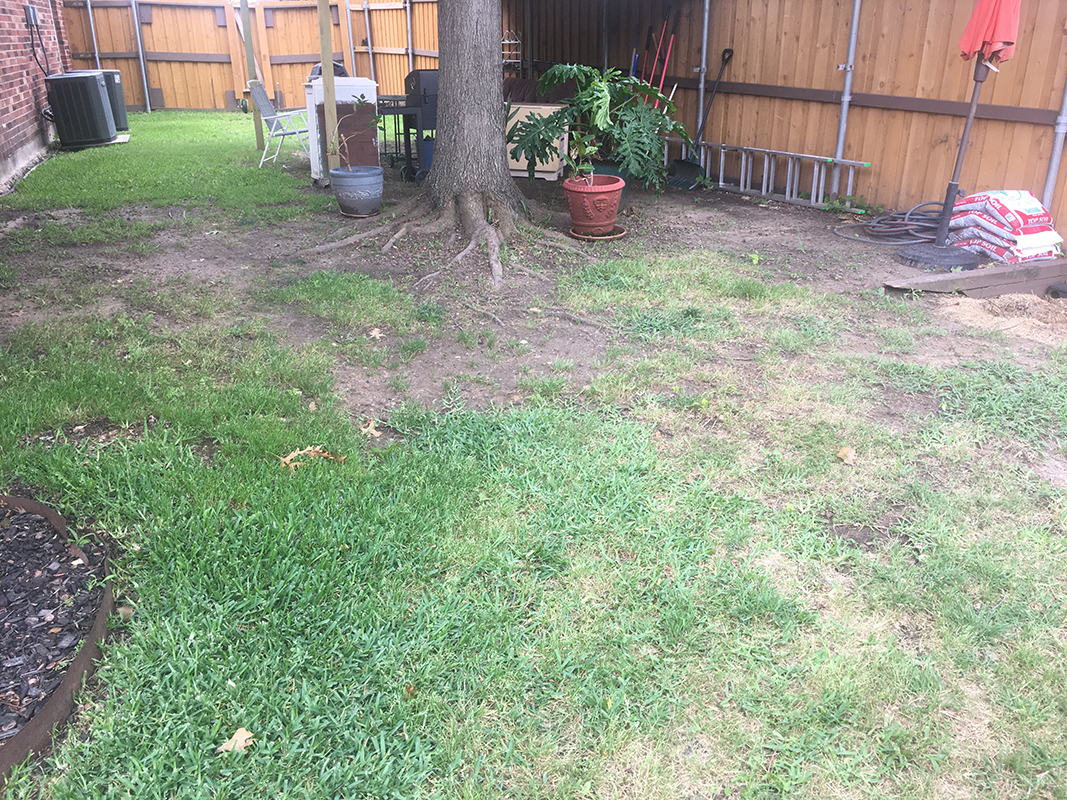
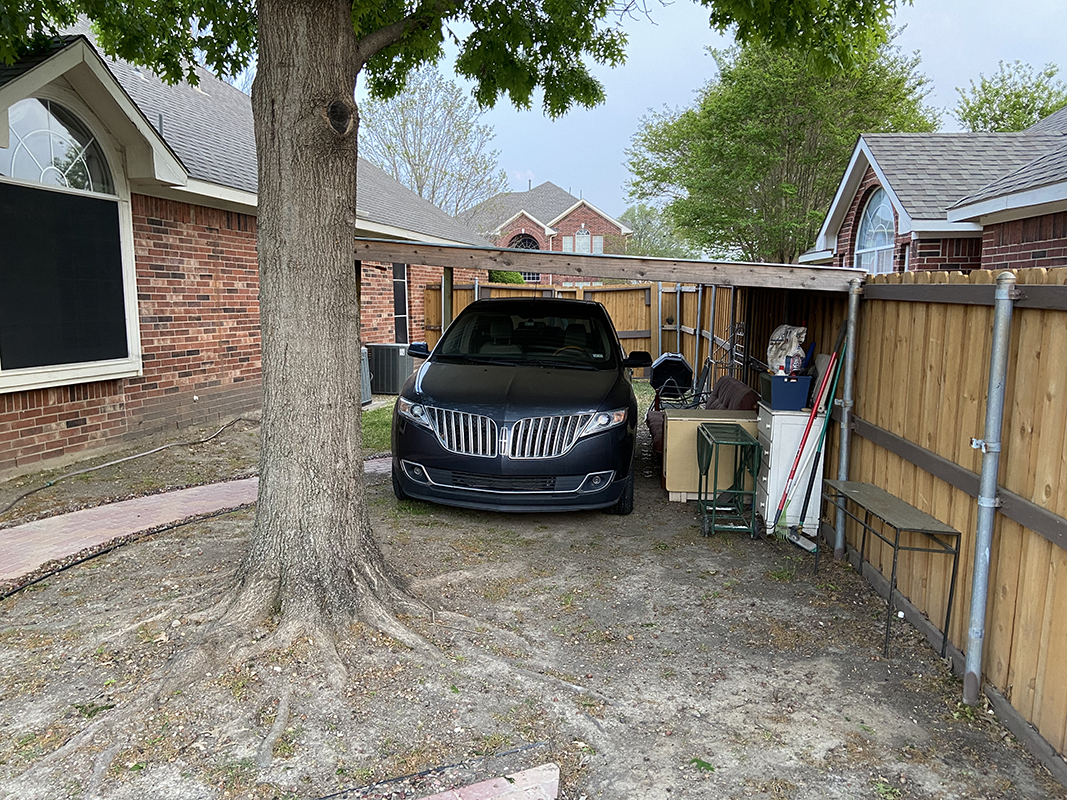
We moved to Texas in 2000 to be closer to our daughter and her expanding family. We found a fantastic house within 15 minutes of her and bought it. The interior was dated but perfect for our needs. The outside however was pretty much an empty yard. There was an old shed in the back and an old car port under a big oak tree in the side yard that the prior owner had used to tinker on his cars. On this blank canvas I envisioned a brick path leading to a large deck with a roof.
The Blank Canvas
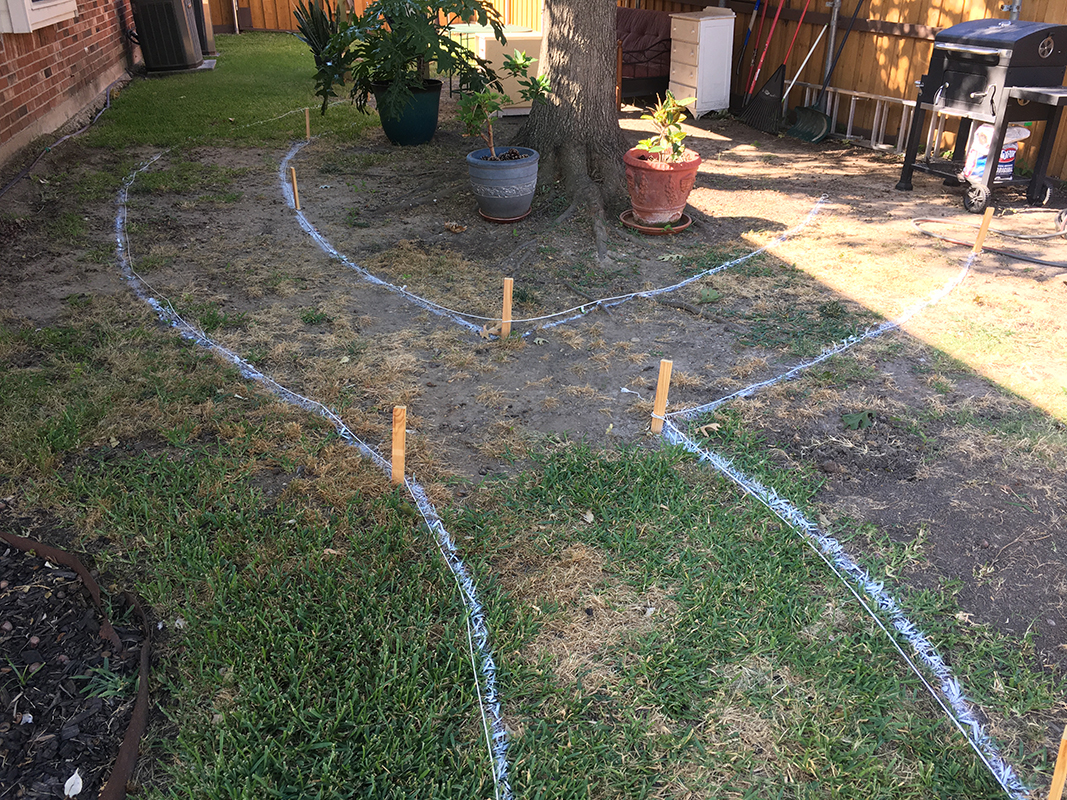
The first phase of the project was to build the brick path from our back door around to that car port in the side yard. This entailed digging a trench 3 feet wide by 12 inches deep for the length of the path, which would split off in two branches, one leading to the shed and another leading to the small grill area of the future deck. The digging was hard and laborious and I did it while training for the Boston Marathon, which made it all the harder. There was a time when work was stopped due to rain that flooded the trench. However, it was a great time playing in the muddy pond for our granddog Annie.
Before – grass, dirt and an old carport
Path Outline
Muddy Annie!
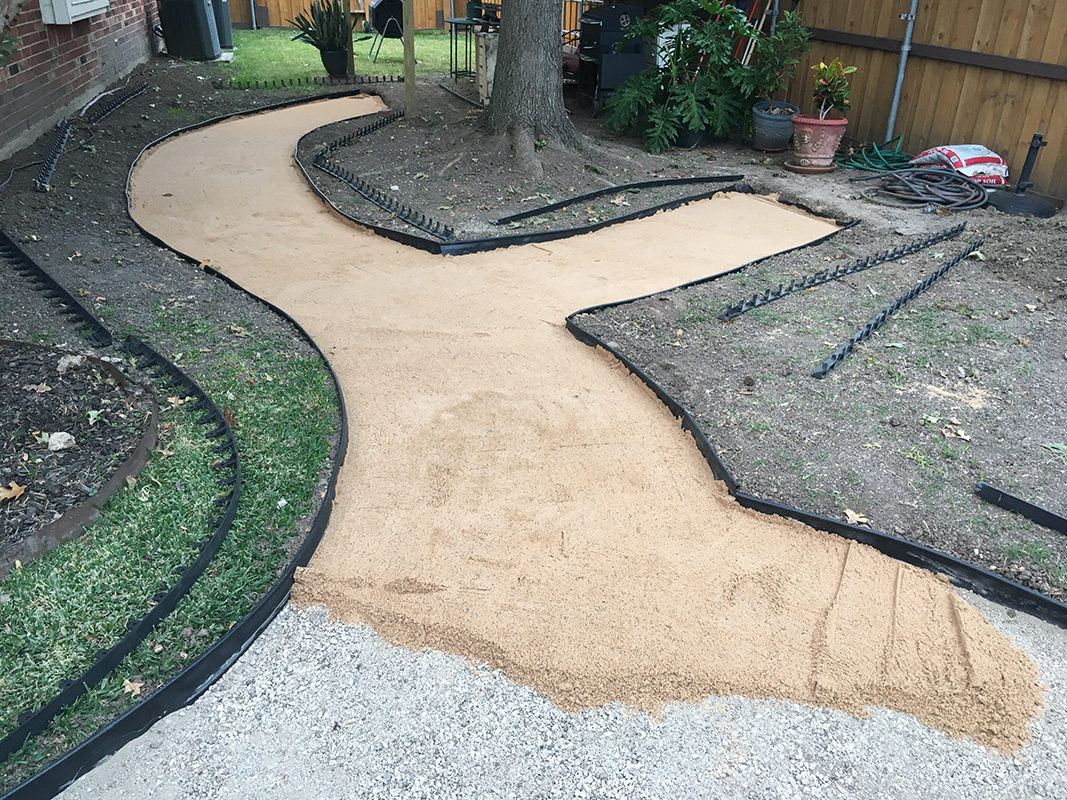
Gravel and Sand
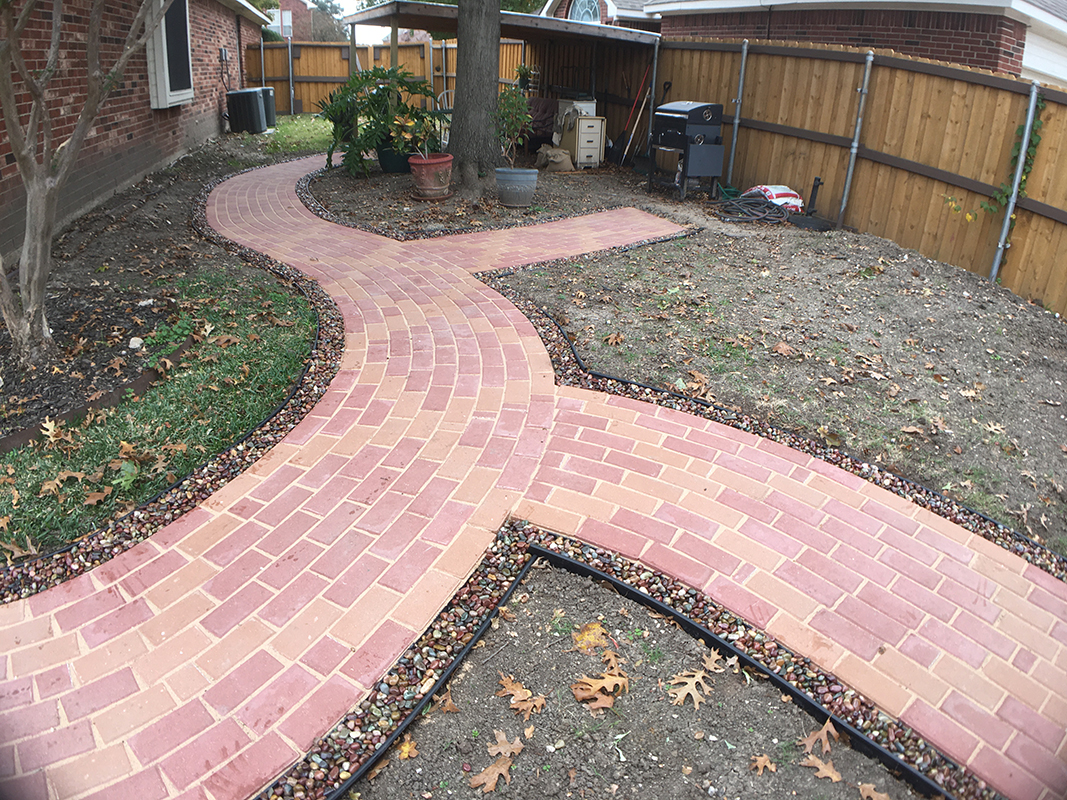
Then came big loads of gravel, sand, and brick. I used two different color bricks with the highlight color forming and X again and again the length of the path.
Path Complete!
Once the path was complete I took a break and focused on other part of the back yard, primarily creating border gardens. I started working on the actual deck in the summer of 2021. This first meant planning it all out on paper and figuring out layout, materials and costs. The deck was designed with 3 distinct areas, a small grill area, a large sitting area and a medium size dining area. It was quite big, 400 sq feet to be exact.
The Big Project
Physically the first thing to do was to get electricity out to the deck area. I had a electrician put a new circuit breaker in and wired it to the outside of the house. From there I dug a trench across the yard to the fence. I installed conduit, wiring and a plug over at the fence so I could have power while building and afterward for lighting the deck.
The deck area before
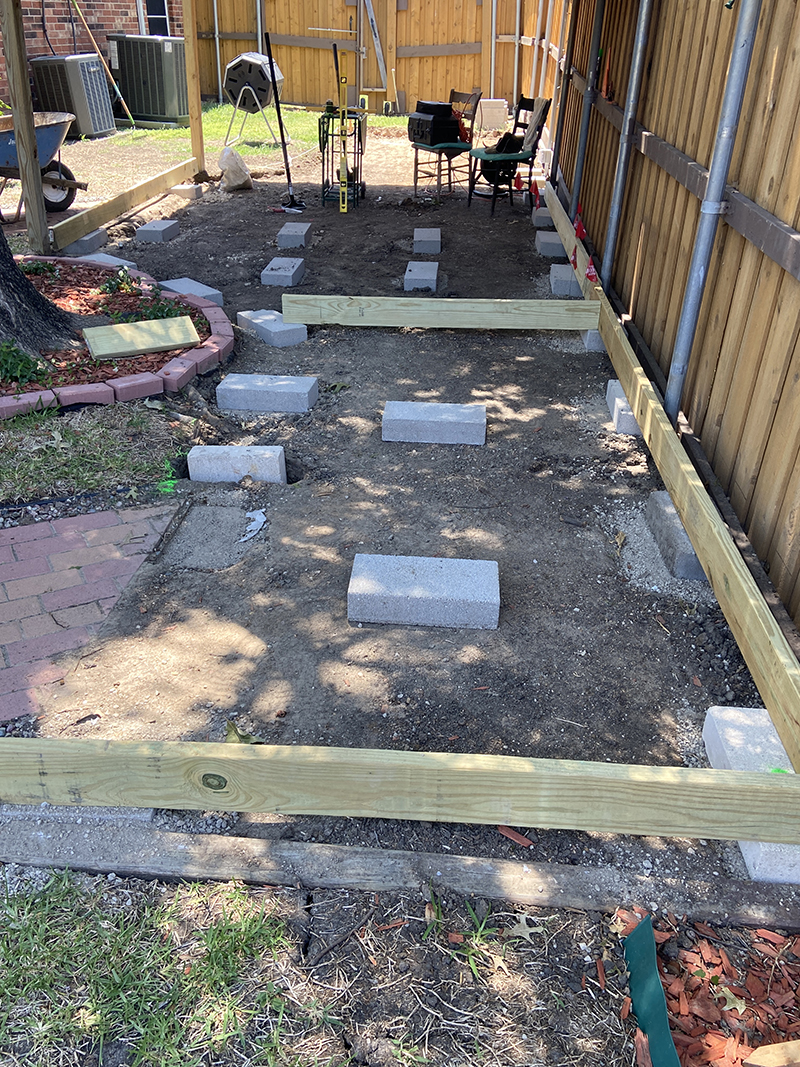
Then it was on to regrading the side yard to be flat. It wasn’t far off from that but it had to be completely flat and just like the path, I had to dig down about 8-12 inches to lay the foundation cinder blocks that the deck would sit on. Once again, hard and laborious and in the middle of a very hot summer!
Throughout the construction I kept thinking the phase I was in had to be the physically hardest part to build so it would just get easier as I went along. This was not true. Every phase turned out to be more physically demanding than the one before it.
Foundation Blocks in Progress
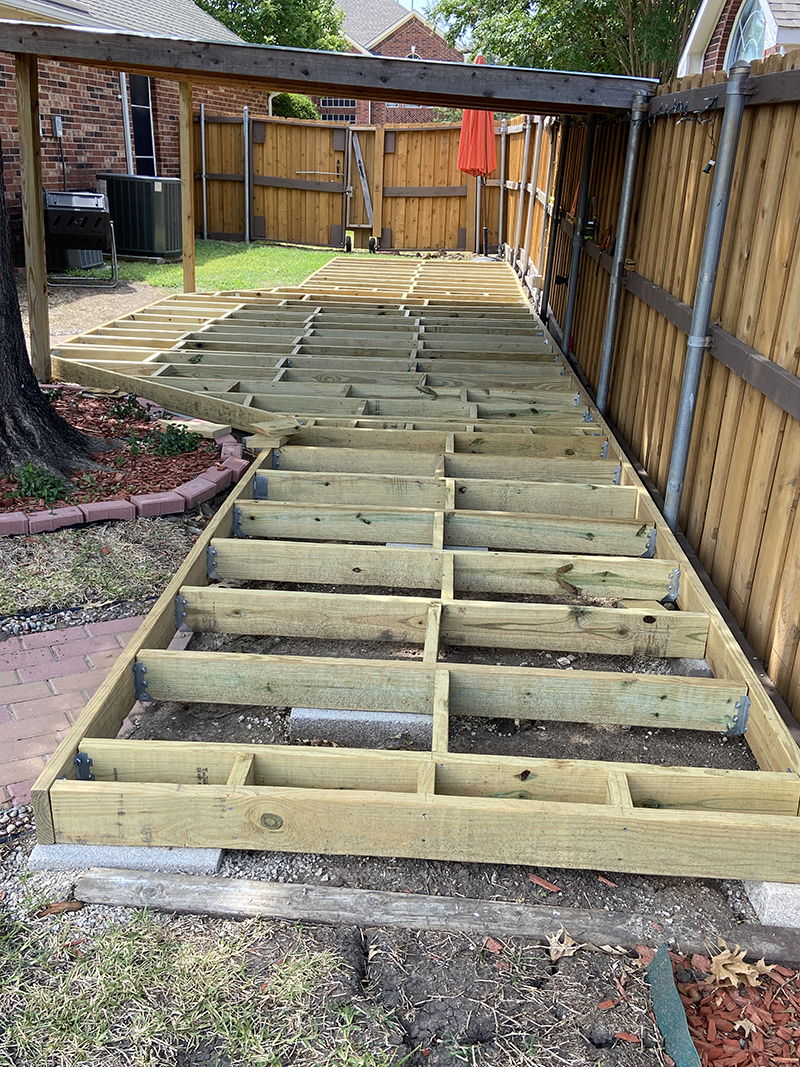
Framing in Progress
After laying the foundation blocks (approx. 36 of them, or maybe 63 of them, I forget now.) I started to build the frame section by section with 2×6 pressure treated pine. Doing it by section was easier to figure things out without being overwhelmed (though honestly it was never not overwhelming!)
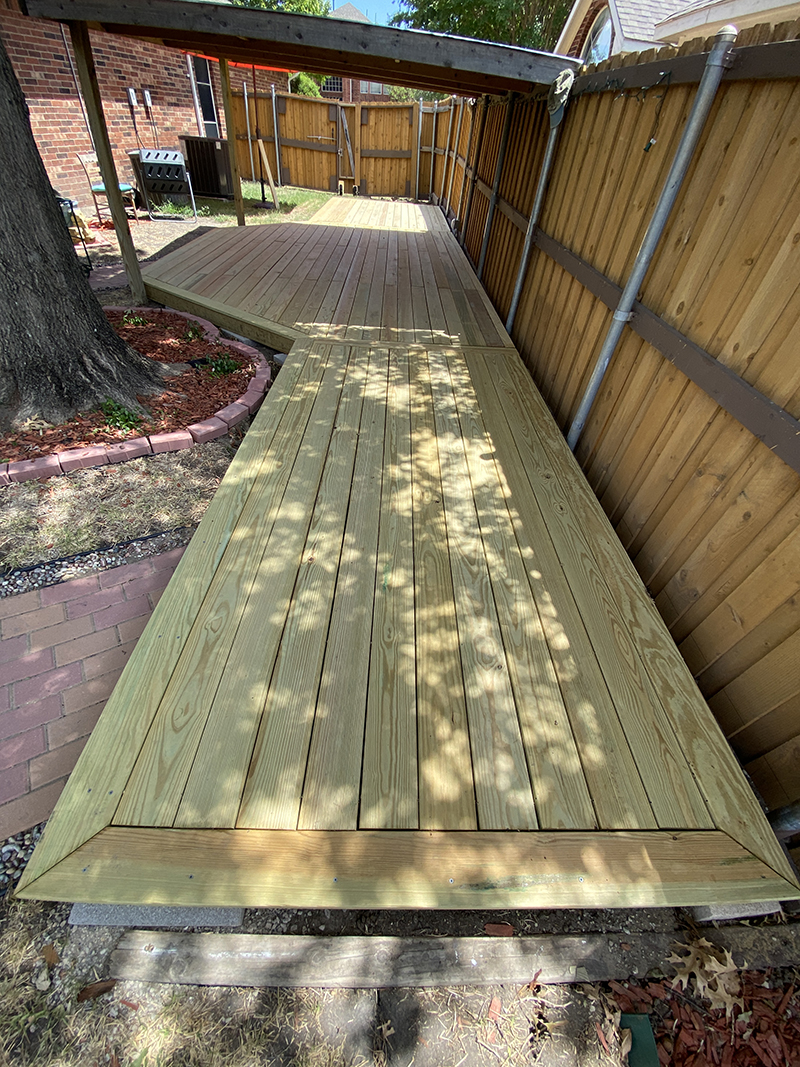
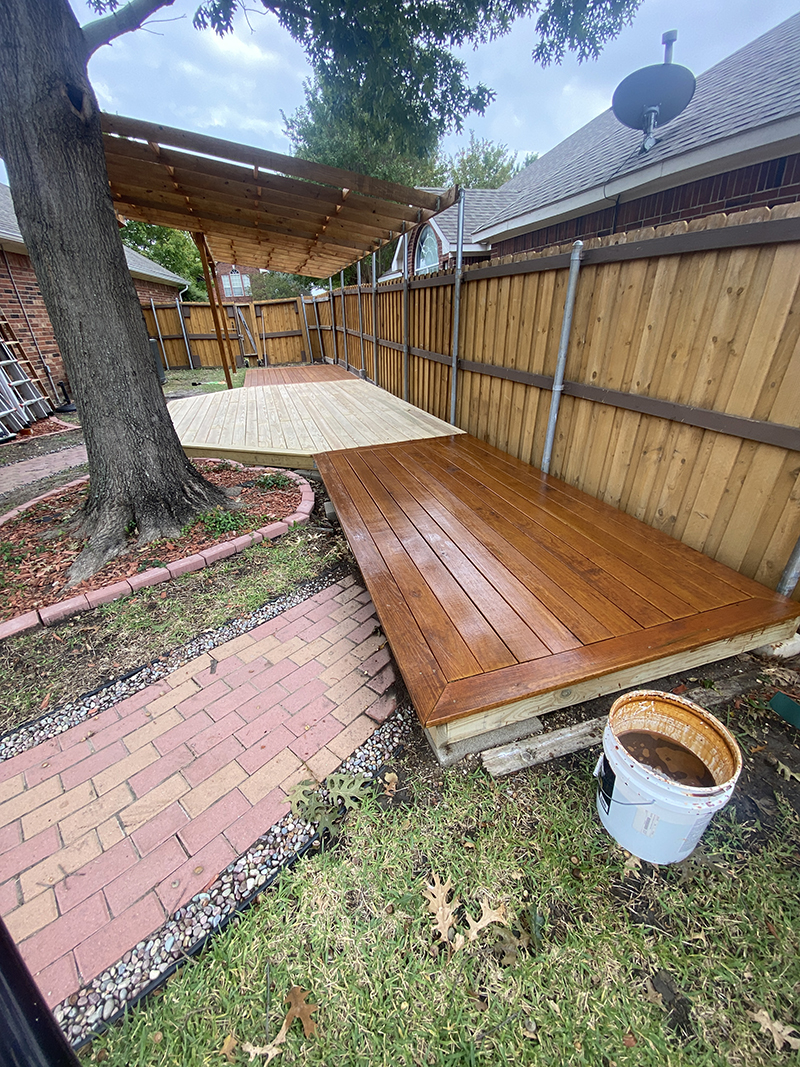
Decking in Progress
Then came the actual decking. I used real wood, not plastic or composite, because of the price and environmental reasons. Once again I built by section and made each area distinct by creating a border around each one. Filling in each area was pretty straight forward until I got to the diagonal section and that took a lot of precise measuring. That was a challenge but I did it without making any big wrong cuts. It probably was the easiest part of the project.
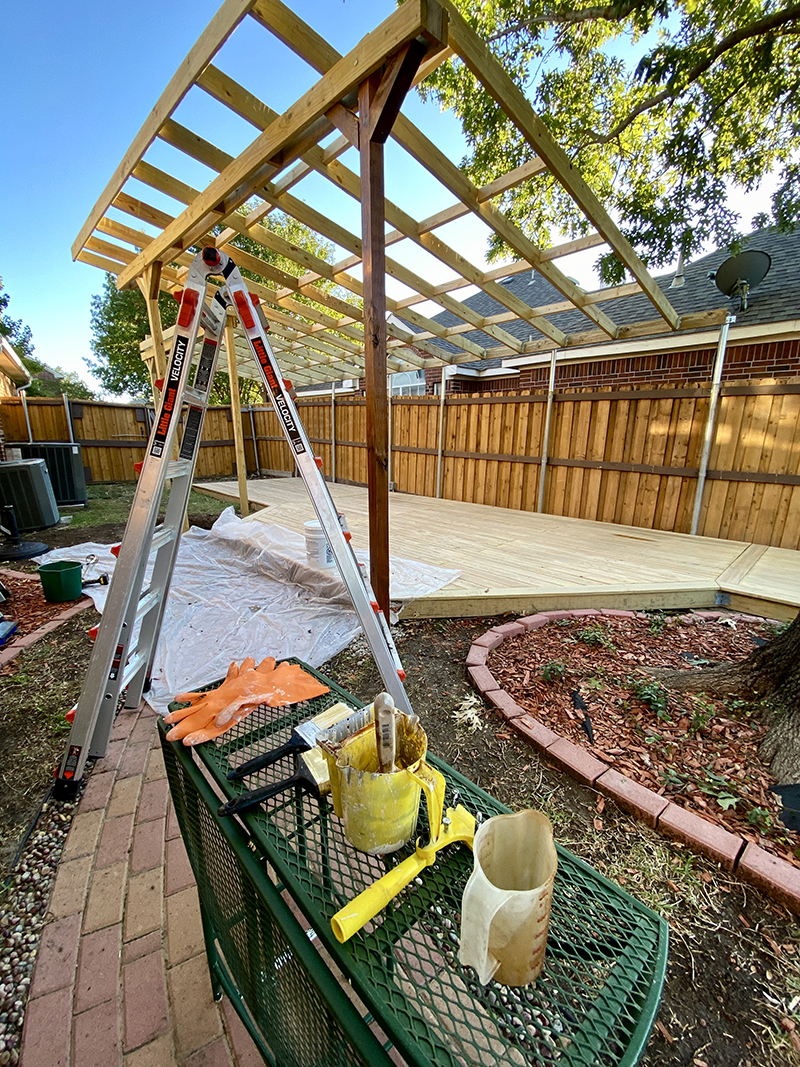
Roof Framing in Progress
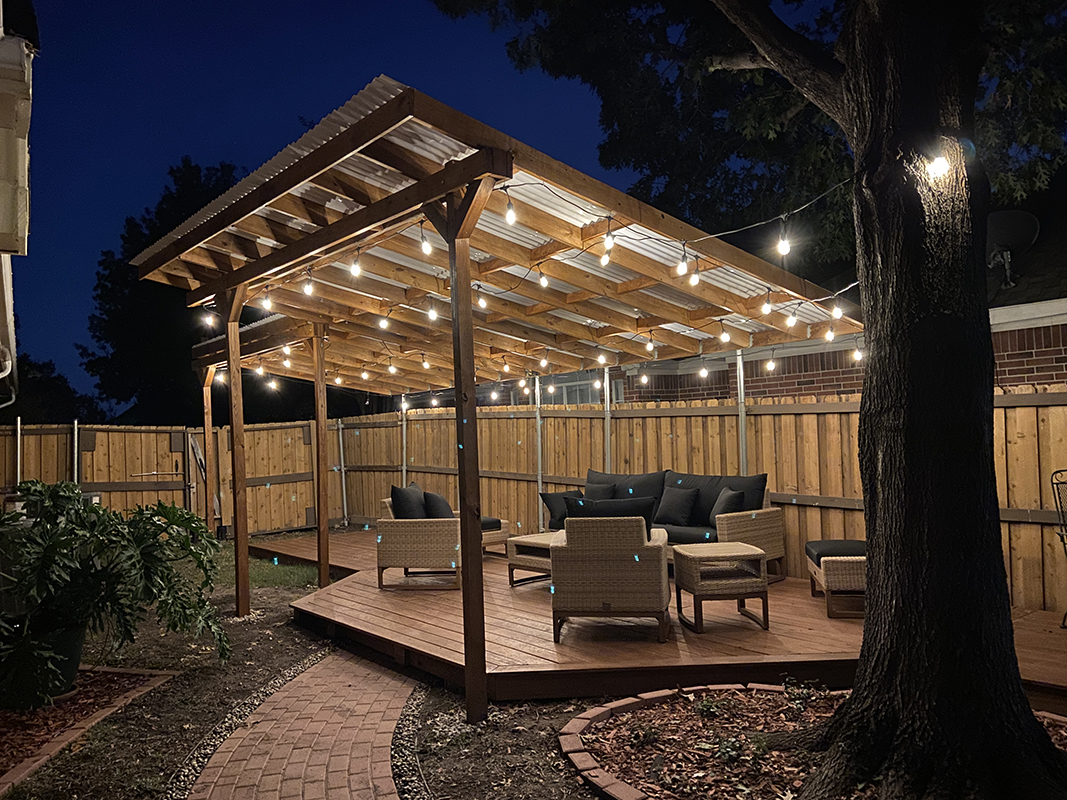
Once that was done came part 3 of the project, the roof. The carport was basically just a slanted roof over dirt but it was very low, so much so that when the raised deck was taken into consideration in nobody would be able to stand up straight. So the old roof was torn down, and the posts that held it up were taken out as well because they were in the wrong spots. The back of the roof was even with the fence so instead of putting posts there I used the aluminum posts that held up the fence and simply added extensions to them. I had to build a frame for the roof just like I had for the deck itself but this was a lot harder because the roof was at an angle and that meant precision measuring once again.
Staining in Progress
Once the frame was up it was time to stain the entire thing. Before staining I had to wash and clear the wood, which meant using a pressurized pump sprayer to get the wood ready to take the stain. For the stain itself I used a soft car wash brush on a pole to do the entire deck and most of the roof (before putting on the roofing material).
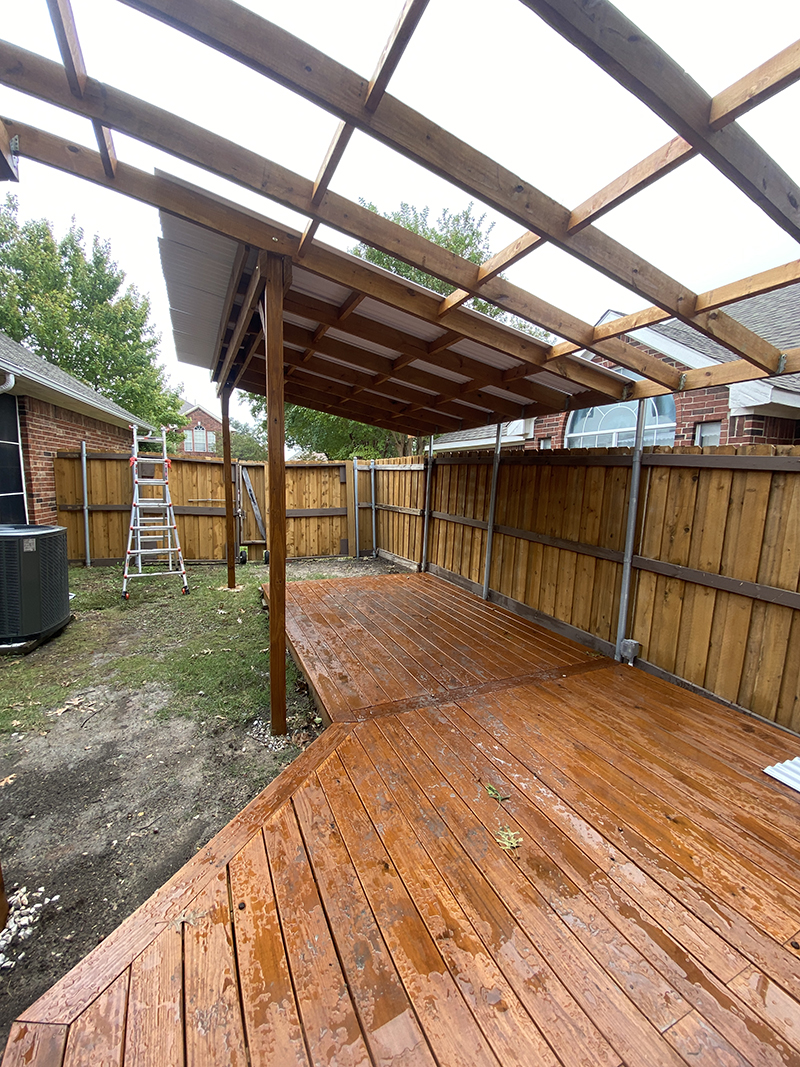
Roof Cover in Progress
The next step was to put on white corrugated plastic roofing, the wavy sort. I took a long time to get them aligned properly, adhered with screws so they wouldn’t come loose in a storm. We’ve had 3 severe wind storms since then and the roof hasn’t moved an inch!
Furnishing
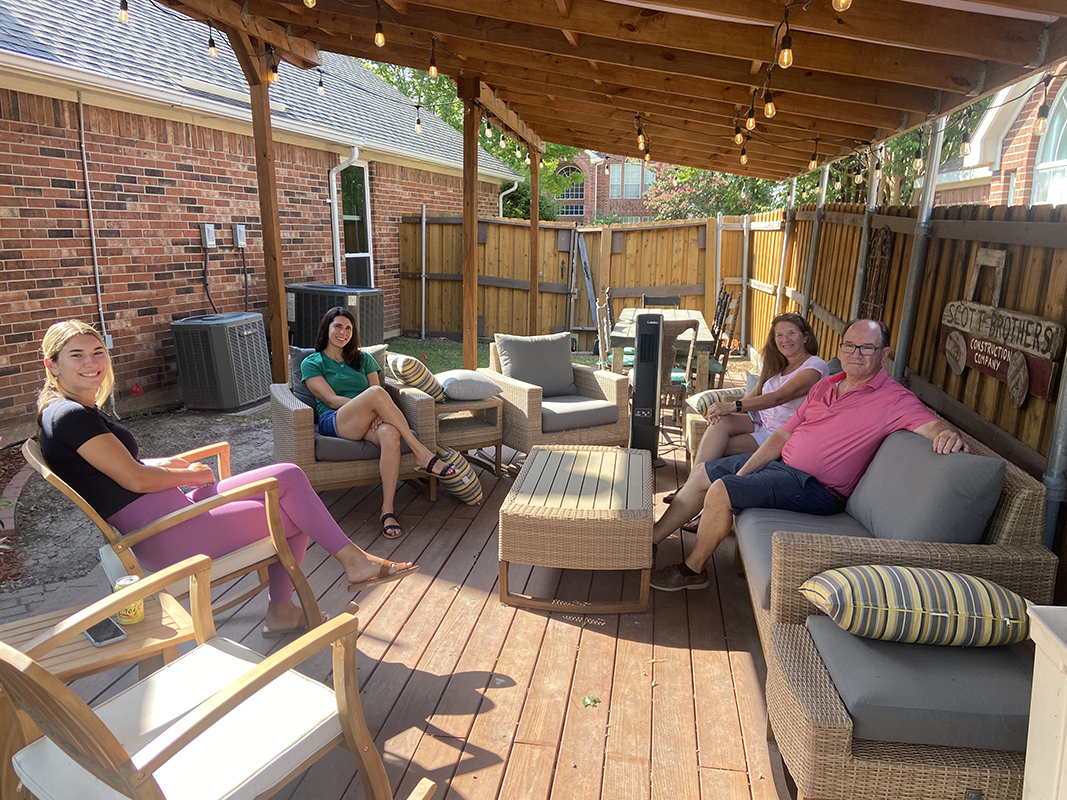
While I was building Linda was shopping. She found a very nice outdoor seating area that fit perfect. She then added 2 rocking chairs and a small table. The area now seats 10 so it’s great for family gatherings.
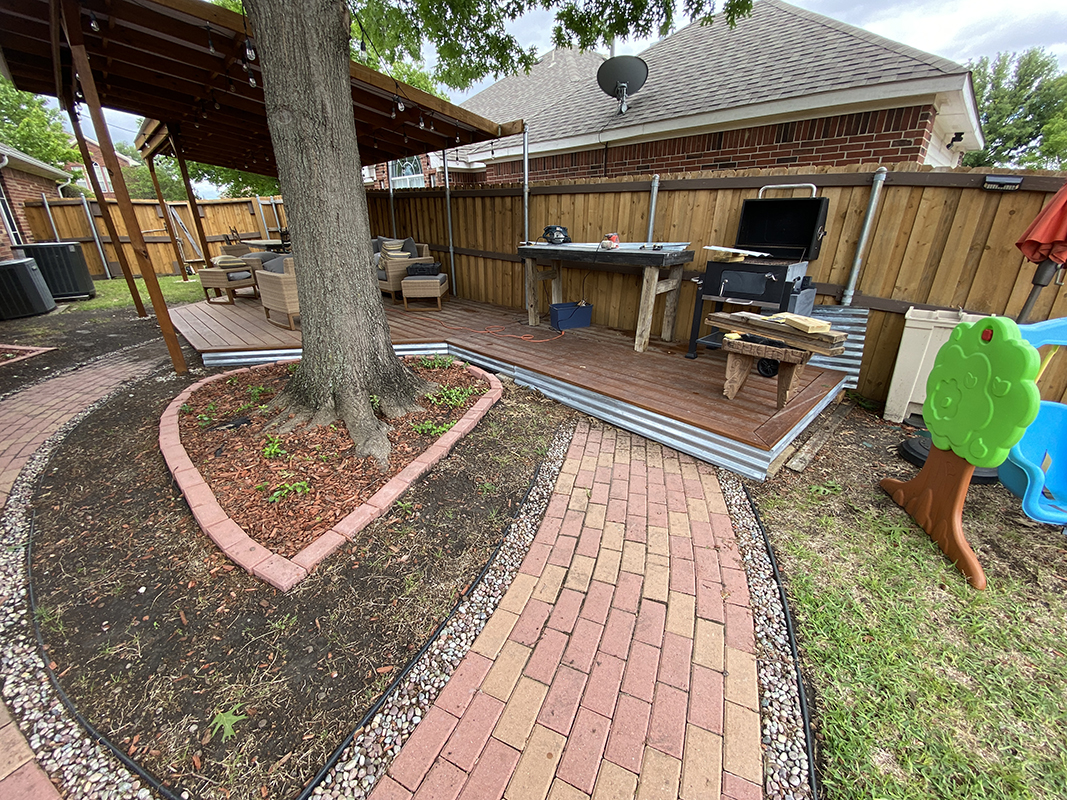
Aluminum Cladding
The final touch was to clad the bottom of the deck, where it met the ground, with strips of the metal roofing I had taken down from the old car port.
The Deck Complete!
I finished the deck and roof and had it ready just in time for Thanksgiving and Christmas, 2021. I was very excited to show it off, especially to my out of town family who was coming over the holidays. But the powers that be decided a cold winter rain would fall for most of thanksgiving week and Christmas week so showing it off basically consisted of people walking out, looking at it, saying cool and then going back inside. It would not be until over a year later that a planned family gathering happened when the weather cooperated and we were able to sit out and enjoy the deck!
The entire project, Path, Deck and Roof took a little less than a year, with about 5 months for the path in 2020 and 6 months for the deck and roof in 2022. I did the entire thing myself with the exception of help from my wife Linda on the setting of the roof posts into concrete one afternoon.