by Marty Coleman | Sep 23, 2014 | California Road Trip - 2014, Family History |
Hello Napkin Kin! Here is the end of the road trip posts.
Day 7
Today I leave Berkeley and head back home to Oklahoma. I am sad to leave so soon, having only spent less than 4 full days with Chelsea and her new family. But with a total of 6 days on the road, it makes for a long time away from home.
I woke up to a beautiful and cool Berkeley morning. Another person was staying at the Airbnb that night and we had met the evening before. She was a runner so we had a great conversation about it, including a bit of coaching from me about injury recovery. She mentioned she was going to go on a run the next morning, up the the same park I had done my trail run the day before. I didn’t ask if she wanted a running partner because I didn’t think we knew each other well enough to get in the car together and go traipsing off into the woods. However, when she got back from her run she said she had decided to just skip the trip to the park and run right from the house. Then I wish I had gone on the run with her! Instead I toasted another runner who happened by as I was packing.
Here is the Airbnb link to Edrie and JoAnn’s spot. If you are going to Berkeley, I highly recommend them.

I said adios to Mr. Otis, telling him to take good care of his mama and daddy.

Then I took a selfie with Chelsea in the bright morning sun of Berkeley and said my goodbyes as I drove off into the sunrise!
___________________
On the Road Again

Photo courtesy of Airbnb and Denise (homeowner)
It took me most of the day to drive to Arizona. I rolled in to the Airbnb in Lake Havasu City and I had time to go see the famous London Bridge that they bought from London and transported piece by piece to Lake Havasu and reconstructed. I had dinner overlooking it. The home was a nice place on a golf course but they had large dogs that barked into the night, right outside my room, that made sleeping not so easy for a while. Luckily they either fell asleep or the owner brought them into his room and I eventually got a good night’s sleep.
_____________________
Day 8
I was out the door and ready to get rolling as the sun rose over the desert. I had a long way to go to get to my destination in Ruidoso, New Mexico.
________________
Trinity and American Pie
I went a secondary route through much of Arizona and New Mexico, south of the usual Route 40 headed east. I was listening to a audio book and not paying much attention when I passed a sign that barely caught my eye. I stopped and did a u-turn to see if it was what I thought it was.
And it was. It was Trinity. The spot of the very first explosion of an atomic bomb. That is one of the most momentous moments in world history, as well as US war history. I just stood there and thought about how that moment changed the world in so many ways. It’s humbling to be in a spot like that, especially one that is so profoundly peaceful, quiet and serene, and realize the violence and unforeseen consequences that came from that moment.
I continued down the 2 lane highway for hours, seeing almost no traffic at all. But then, I turned a long sweeping arch and found myself smack dab in the middle of a party. Hundreds of cars and people parked on the side of the road in ‘Pie Town, New Mexico. I think the actual town consists of just this store, the ‘Pie-o-neer’.
It turns out there was a pie festival with contests and awards, pie making demos and more. I didn’t see much of that but I did walk among the booths and found a couple good things to bring home for Linda.
This lady, Cindy Yarmal, was selling veggies on the front porch of the pie shop while tourists mingled and a good ol’ boy band played some tunes on the other end of the porch. I asked her if I could take her photo and she obliged me. After I sat and enjoyed a slice of Blackberry pie as the world swirled around me.
__________________________
Snowcap Adobe
I arrived at ‘The Snowcap Adobe’ just as the sun had set. I had contacted the owner, Susan, earlier in the day to let her know my time of arrival and she told me she had her best friend over and chili on the stove, asking if I would want some for dinner instead of having to find food before I arrived. That was a welcomed idea and I took her up on it!

Photo courtesy of Airbnb and Susan (homeowner)
Her home was amazing. It was built by her family many decades ago and she had updated it in recent years to make it a welcoming spot for travelers. It felt homey and warm. The three of us sat at her kitchen counter and she told me the story of her family and her home. Susan was a great story teller, especially about her grandfather, a well known artist in the mid-twentieth century regionalist tradition. She had even done her Ph.D. thesis on his use of symbolism in his art.

Photo courtesy of Airbnb and Susan (homeowner)
This was my bedroom for the night, comfortable and genuine New Mexico.
___________________
Day 9 – Headed Home
Finally I was on my last day. I once again left early, before Susan had awoke. This is an early morning view of her solarium that her mother tended while she was still alive. It is still filled with plants but Susan says she forgets to water them. There are a lot of plants, I probably would too.

I drove northeast through rural New Mexico and Texas until I reached Amarillo. During that stretch I found one last interesting place. Alanbeen, Texas was a gas station and a motel. That was it as far as I could tell. The station said it was the post office too so I think that pretty much says it all.
The gas station consisted of one pump. Surprisingly it did take credit cards. But I couldn’t pass up the chance to go into the convenience store so I let it run and went inside.
And good thing I did, because otherwise I would have missed this sexy Texas miss smiling at me! The place was a hoot, covered top to bottom with stuff, most old Texas memorabilia and trinkets.
And then was a beeline home. I arrived in time to have dinner and relax, hear about Linda’s bachelorette week and show her some photos of Mr. Otis!

And that’s the end of this road trip! Next stop will be the opposite coast to visit my OTHER grandchild, Vivian. Not sure when that will be but I will let you know.
____________________
California Road Trip
Part 1
Part 2
Part 3
Part 4
_____________________
Like this:
Like Loading...
by Marty Coleman | Sep 22, 2014 | California Road Trip - 2014, Family History, Travel |
Continuing my epic road trip to California and back…
__________________
Day 6
By day 3 in Berkeley I had a rhythm of going to the French Hotel and Coffee Bar on Shattuck to pick up some pastries and coffee, then heading over to Chelsea’s house. She seemed thankful for the Cafe Mocha that morning but it sort of looks like Otis is in need of it even more.
________________
One of the cool things about staying at Airbnb spots is seeing homes uniquely designed.

My hosts in Berkeley had devised a pretty cool way to both display and have available their collection of earrings. they simply hooked them on the bottom of the sheer curtain in the guest bathroom. I don’t know if it originally was a way to keep the curtain weighted when the window was open and the wind was blowing, but it made for a fun and unexpected design element in the bathroom.

And here was another design element in the bathroom I thought was pretty cool. It was a functional art piece on the wall and I liked it! And no, I did not steal any of the belts, though the green one was tempting!
_______________________
Graham had to rehearse for a big show he was going to be in so Chelsea, Otis and I took a foray into the hills of Berkeley. We went up to the very top of the area, to Tilden Regional Park. It is a beautiful and serene spot not at all far from the bustle of the East Bay. We chose Lake Anza because Chelsea could sit and nurse Otis while I went on a run around the lake and presumably I would not get lost. I took a few spurs off the lake not realizing it but I made my way back without too much consternation on anyone’s part.

This is about a 3rd of the way around the lake. Chelsea and Otis are just to the right of the marker in the water in the middle of the image. On the left is a popular beach that allows you to swim in the lake. It even has lap lanes beyond the play swim area. I thought that was a pretty cool idea.

Right after taking the vista shot of the lake I turned was about to restart my run when I found this fellow fetching balls while wearing a doggie floatie vest. I immediately thought of a friend of mine back in Tulsa, Rosemary Dougherty, who has a serious love affair with all things bulldog. I knew it would make her happy to see him and it did.

In the meanwhile, this is the trail I was running. I thought I was going to be running a flat trail around a lake, but it was anything but. It was a challenge! I twisted my foot at one point but didn’t really feel it until that night and it wasn’t serious.

When I returned Otis was a happy camper, as you can tell!
After Otis was filled we took a hike down Chelsea’s favorite trail. It was easier than the running trail I found, that is for sure. We think of redwoods as being in big forests all by themselves but throughout Northern California there are many places they grow in and among a wide range of trees. Tilden Park is one of those places.
Along the trail we found an old pump house. I loved the stone around the empty window and had Chelsea and Otis sit in it for a portrait.

I got Chelsea to take one of me as well.

Chelsea kept Otis in the wrap for the entire hike. It was long and got a bit warm by Berkeley standards (still felt cool to someone from Oklahoma though). It translated into both of them being very tired when we returned to her apartment and they settled into a nice nap.

While they slept Graham and I walked down to Shattuck Avenue, to an area of Berkeley known as the Gourmet Ghetto. Destination: The Cheese Board. As you can tell from the line in the photo, it is a popular place. It sells only one type of pizza per day. No choice. It’s listed on a board but all those people in line? They don’t check first to see what the type is for that day. They know it will be great and they are going to get it no matter what. We were the same way. Turned out ours was fantastic, with guacamole and cilantro and peppers and sausage (if I remember correctly). YUM! They also had a cool jazz band playing. It was quintessential Berkeley.

Later that night Otis’ Godmother Lina came over to see Otis and meet me for the first time. We hung around for a long time talking about all sorts of things. She had just returned from her umpteenth time at Burning Man so she had lots of stories to tell. Chelsea and she gave me the low down on how to prepare and experience Burning Man in case I ever make it to the event. I want to and hope to within the next few years!
________________________
California Road Trip
Part 1
Part 2
Part 3
Part 4
________________________
Like this:
Like Loading...
by Marty Coleman | Sep 21, 2014 | Photographic Sunday |
Muse
Recently I did a fitness photo shoot at Chandler Park here in Tulsa, Oklahoma. I was using the shoot as a scouting trip for a larger shoot I am planning with my PHOTOG group I help lead here in town.
I was originally thinking of the shoot as being runners and cyclists but then decided Yoga would be best in an environment of rocks, cliffs and tree roots.
I knew A friend of mine, BR, who had modeled for me before, was doing Yoga regularly and asked her if, once again, she would model for me. She was more than up for it and these photos are the result of our collaboration.
It was fun, but it was not an easy shoot. The landscape was rocky, with fallen trees, sheer rock faces and trails that went up and down at steep angles. In addition it was a hot and steamy morning that had us sweating from the git go. While I had to carry a camera and a few bags and that took some effort, BR did the bulk of the hard work, posing in intense yoga poses, climbing up and down high stone monoliths, balancing on very small spaces very high up. She’s a fantastic muse who inspires me with her courage, creativity, intelligence, beauty and fitness.
Hidden Yoga
Around this same time I gave a lecture at my photo group called ‘The Photo Essay’ in which I explained some details of what constitutes a photo essay and what gave examples from photographers past and present.
I chose a small group of images from my Yoga shoot that I felt held together as an essay on the idea of the yoga practitioner being hidden in the landscape.


Yoga on the Rocks
There were a number of other photos where BR was not so well hidden. That group is titled ‘Yoga on the Rocks’. Here is a selection.


Through it all BR kept a smile (except when I asked her not to) and a great attitude!

_____________________
Photographs by Marty Coleman
_____________________
Like this:
Like Loading...
by Marty Coleman | Sep 19, 2014 | Well Wealth - 2011 |
After a bit of time away from drawing I am back on my Wealth Series.

Without
A typical biography will often have a line in it that goes something like this, “We didn’t have much money growing up, but we never felt poor.” Why is that? Why do some poor families feel poor and others not? What is it that divides them?
Who is Wealthy?
Of course, necessities are one thing. People who don’t have a safe roof over their heads, who can’t get enough to eat, likely they feel as poor as they are. But just up from that level of poverty, what about the family who can’t afford vacations or new cars or cable TV or new clothes? Why do one of those families feel poor and another not? I would think often it would be about comparisons made with others. Not necessarily by the kids, but by the parents. The parents might be constantly saying, “I wish we had this, or I wish we could do that.”
The Never Ending Climb
You would think that wouldn’t be a big deal the wealthier you get. But the truth is it gets MORE severe the more money you have. One family takes ski vacations to Aspen, but your family can only afford to ski locally in Vermont. Sounds silly that one would feel deprived, but if the parents are constantly harping on how they can’t afford something then the kids will learn they indeed don’t have enough no matter how much they have.
Appreciation and Gratitude vs Envy
The key for me is appreciation and gratitude. For example, I appreciate my little charcoal grill out back. I don’t look at it and see that I don’t have the same giant gas grill my friend has, I look at it and see the enjoyment I am getting from cooking on it. I am grateful for it. If someday I need a new grill I will figure out how big I need it to be for me and my family and I will do my best to get that grill. But it won’t be because of envy over what someone else has, it will be based on my need and what I can afford. And I will be happy with that.
You can see the entire Wealth Series here
___________________
Drawing and commentary by Marty Coleman
Quote by Epicurus, 341 – 270 B.C., Greek philosopher – Find out more about Epicurus here.
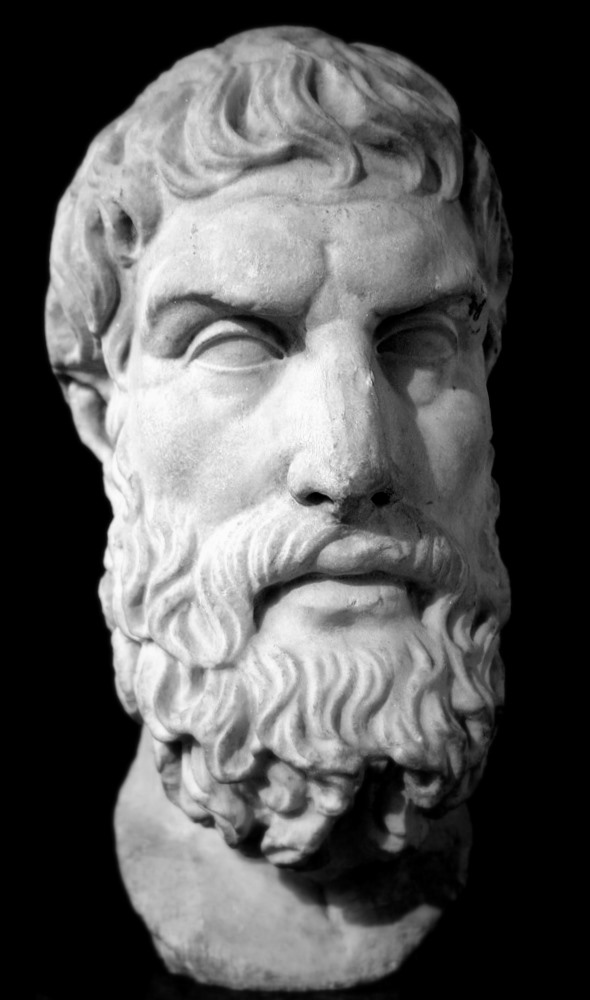
Licensed under Public domain via Wikimedia Commons.
______________________
Like this:
Like Loading...
by Marty Coleman | Sep 18, 2014 | California Road Trip - 2014, Family History |
Hello again Napkin Kin! Here is the part 2 of my epic road trip to the west coast this past week.
Day 4
Since Chelsea and Graham live in a studio apartment with a new born, my housing was obviously going to be elsewhere. I found a great Airbnb spot about 6 blocks away in the Berkeley Hills. This is their living room overlooking the small winding street below. Edrie and her partner JoAnn were friendly and hospitable hosts, with coffee in a French press ready for me each morning.
__________________
Chelsea’s family unit had an appointment on Tuesday morning so I was solo for a few hours. I took advantage of the time to get my first run in. I had to return the U-Haul trailer and the location was way down in flats of Berkeley, near the San Francisco Bay. I figured there had to be running trails near the bay and I found a great one that goes for miles and miles. Within that trail was a loop that went out into the bay towards the Berkeley Marina. It was there that I found Cesar Chavez Park, with a great latticework of dirt and asphalt trails.
The sky was overcast and the air was cool with that fantastic California ocean breeze. After a summer of 90 + degree running days in Tulsa, it was exhilarating to run in cooler temps. It wasn’t just the temps but the surroundings. This little peninsula of a park was beautiful and natural. You would not know you were in the middle of one of the most densely populated areas of the United States, that is for sure. But as I crested over a little hill in the middle of the park I realized where I was.

It may look like just a trail with water in the background but look close. The water leads to a bridge on the left, which leads to a city which lead to another bridge in the center right. One of the best things about running in new places is how you always end up seeing that place in ways you can’t anticipate. Seeing the Bay Bridge, San Francisco and the Golden Gate Bridge all at the same time from this angle was fantastic. It was so cool I made this loop about 3 times, going 2 miles further than I had planned, just so I could experience it longer.
Then of course there is the more mundane angle to a run. What can be a majestic bay is always a small and intimate one with birds and mud and grass just like the Arkansas River back home or any other body of water. But look close again and there are always things to admire and wonder at.

Here is another thing runners often see that others don’t, the homeless. Of course in most cities you don’t find them waking up with this view. A night outdoors might be a tad bit easier on the SF Bay, but overall I have a feeling the burden is the same no matter where it is.

As I turned around at the halfway point of my run I glimpsed the BerkeleyMarina and the Berkeley Hills from whence I had come.
__________________
When I returned the Coleman-Patzner family were folding laundry and playing. No worries, he isn’t about to break his neck. He does a lot of backward and upward bending motions and his neck is already quite strong. I experienced it first hand. Not bad for a 6 week old!


Otis and I hung out on the porch for a while. He was quite mesmerized by the amazing stories of my many road trips, as you can tell.

So much so that it wore him out. Here he is dreaming of going on an epic road trip with Papa Marty.
Even though Linda wasn’t there, I knew it was what she would have done so Chelsea, Otis and I went on a shopping trip that afternoon, getting stuff for the kitchen and the rest of the apartment. We also got fixins for a family dinner.

Graham’s parents, Curt and Karla Patzner, came over for dinner. I had met Karla before but hadn’t met Curt. I liked him because well, he had a nice hat. What more did I need to know, right? I made Linda’s famous Smoked Salmon Pasta with lemon and Dill. It went over pretty well!
____________________
Day 5
It was babysitting day for me! Graham and Chelsea took a break in the afternoon to go see a movie and Papa Marty and Mr. Otis had our first bonding time alone.

But first Graham got Otis all ready for our big adventure. I don’t know Graham all that well, having only met him a few times, once when I visited California last year and another when Chelsea and he came to Oklahoma on their own epic road trip in the spring. That trip was a 6 week music tour around the entire US of A in a little Saturn car while Chelsea was preggers so yes, it was truly epic! Graham has been a very attentive and hands on father, playing with Otis, changing diapers, just taking care of business as a father. It’s been good to see.

While he slept I did a bit of work in the kitchen, moving out the fridge to put in a plug and mopping the floor. After that we went for a walk around the neighborhood. I introduced him to the jungle that is in the Berkeley Hills, with an elephant standing guard in a corner yard.

It was made of old pieces of tires. It was amazing.

A lot of Berkeley is amazing. While most homes don’t have huge land mammals in their yards, most of the homes have fantastic flowers and landscaping in their hilly lots. The homes are of all sorts, with a large percentage being of the Arts and Crafts movement, one of my favorite architectural styles.
The day ended with us going out to a Himalayan Restaurant on Shattuck Avenue in what is known as the Gourmet Ghetto area of Berkeley. It is too, amazing amount of restaurants in a very short stretch. It was really good!
______________________
California Road Trip
Part 1
Part 2
Part 3
Part 4
______________________
Like this:
Like Loading...