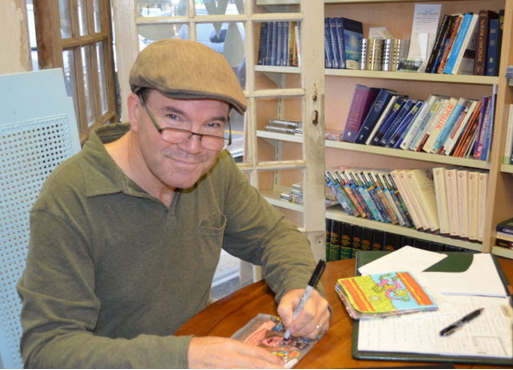
by Marty Coleman | Oct 18, 2012 | Art, How To Draw A Napkin - 2012 |
Come on, let’s have a show! Here is what you do next in your journey to draw a napkin.

Step 3a-3d: Repeat steps 1a-1d
Step 3e: Draw yourself at your big exhibition opening greeting all the admiring guests.
Step 3f: Color in the drawing of yourself at the big opening.
Step 3f: Make sure to include your art and the rich and famous collectors, dealers and critics who will be there.
Step 3g: Show yourself complimenting them on their outfit and hair (if they have any).
Step 3h: Show yourself selling your work. Tell them the piece would go well over their bed.
_______________________
Concept, drawings and commentary by Marty Coleman, who is no relation to the artist in the drawings. Really.
_______________________
Fact of the day:
There are over 60 Museums on the Island of Manhattan, New York City.
_______________________
Like this:
Like Loading...
by Marty Coleman | Oct 17, 2012 | Art, How To Draw A Napkin - 2012 |
I hope this public service series on how to draw a napkin is helping you.

Steps 2a-2d: Repeat steps 1a-1d
Step 2e: Go to art college or at least a big empty space and draw naked people a lot. Men, women or hermaphrodites are acceptable.
Step 2f: Move from drawing naked people to painting naked people. Use pretty colors.
Step 2g: Practice being an artist for 30 years (this is an important step, don’t skip it).
_____________________
Concept, drawings and commentary by Marty Coleman
_____________________
Fact of the day:
Top ten most popular subjects in art (according to a survey conducted by Art Business Today magazine (UK)
1. Traditional landscapes.
2. Local views.
3. Modern or semi-abstract landscapes.
4. Abstracts.
5. Dogs.
6. Figure studies (excluding nudes or nakeds).
7. Seascapes, harbour, and beach scenes.
8. Wildlife.
9. Impressionistic landscapes.
10. Nudes (this includes Nakeds as well).
Like this:
Like Loading...
by Marty Coleman | Oct 16, 2012 | Art, How To Draw A Napkin - 2012 |
Many people have asked me to teach them how to draw a napkin. So here is my FREE tutorial. Pay close attention.

Step 1a: Get a napkin
Step 1b: Get some markers
Step 1c: Draw a rectangle in the color of your choosing (note: creative moment of free will)
____________________

Step 1d: Write the title in the rectangle
Step 1e: Draw a line around the rectangle (1d and 1e are interchangeable, but it is more dangerous)
_____________________

Step 1f: Draw another rectangle (this time using another color of your choosing)
_____________________

Step 1g: Write the subtitle in the rectangle
Step 1h: Draw a line around the rectangle (you do not have to repeat the border line, it’s already there, SCORE!)
_____________________

Step 1i: Draw someone learning to draw (be accurate) under the 2 rectangles
_____________________

Step 1j: Color in the drawing of someone learning how to draw (use pretty colors)
_____________________
TADA, you are now done with Step 1. Now practice.
_____________________
Concept, drawings and words by Marty Coleman
_____________________
_____________________
Like this:
Like Loading...
by Marty Coleman | Oct 12, 2012 | The Judge Knot - 2012 |
It would be a sin not to post one final napkin for Judge Knot week!

I Hate Sin
I know you might be thinking that sounds like a nice Christian thing to say but I don’t mean it in the traditional way. What I mean is I hate the word sin. I hate the mentality that calls so much of our behavior sin. In my mind it is both archaic stylistically and ineffective practically to label everything a sin. Why is that? Because labeling something sin attaches an immediate moral judgment to it. What’s wrong with that you say? It is fine when it actually has something to do with morality, and indeed there is plenty of behavior that does. But most of what people call sin we know now isn’t nearly as much about morality as it is about biology and chemistry and psychology.
Off the Hook?
Wait a second, isn’t that going to lead to people using excuses for continuing on in their bad behavior? Well, first off, Christianity already has the ultimate safety valve in place, that is the doctrine that you are not saved by works but by faith. No good thing you can do (on your own) can save you and no bad thing you can do (once you have accepted the doctrine) can destroy you. So, people already have their excuse if they want it. But further than that, getting rid of calling behavior sin and beginning to call it something judgment neutral doesn’t make excuses easier, it makes them harder. Why is that? Because accusations and judgment always lead to a defensive response. Saying someone is bad demands the person respond with why they are not but saying someone might have a biological condition that needs to be explored has no accusation or condemnation. You aren’t condemned if you break your arm and someone says you have a broken arm and need to get it fixed. It’s judgment neutral and you are free to get the arm fixed.
One Deadly Sin
Let’s take one of the traditional sins, gluttony. That is usually attached to someone being obese. Condemning and judging them for their obesity doesn’t take one step towards them overcoming their ‘sin’. Once they are judged, they still have to figure out what it is that is going on in their bodies, their history, their habits. They still have to take deliberate steps to change what they can and move in a new direction. If the reason has to do with family eating habits, then that needs to be addressed. If it has to do with a imbalance in the thyroid, that needs to be addressed. If it is a psychological or emotional issue, that needs to be addressed. None of those reasons have anything to do with the original comdemnation/judgment so why add it in the first place?
Forget Judgment, Remember Reasons
A better avenue is to forget the judgment and just start with reasons. These are real reasons that we can do something about, not reasons rooted in an archaic and simplistic understanding of humanity. It’s important to note, we aren’t saying there isn’t a problem when we avoid the judgment of calling something a sin. We are saying the problem can be dealt with and solved by dealing with what is really happening, not what some religious doctrine demands we call something.
____________________
Drawing by Marty Coleman
Quote by Anonymous
____________________
Fact of the day
The Seven Deadly Sins were first codified by Pope Gregory and popularized by Dante in his ‘Divine Comedy’.
Here is the list in Latin:
- luxuria (lust)
- gula (gluttony)
- avaritia (avarice)
- Socordia (sloth)
- ira (wrath)
- invidia (envy)
- superbia (pride)
______________________
Like this:
Like Loading...
by Marty Coleman | Oct 11, 2012 | The Judge Knot - 2012 |
I got roped into drawing Judge Knot #4 today!

Murder Suicide
I hate hearing about murder suicides. It’s always so completely tragic in every way. It’s the same with judgment. It kills you and the one you are judging. Now obviously I am not talking about physical death. I am talking about emotional damage.
Damage to Yourself
Being a judgmental person stifles you. It stunts your growth, diminishes your joy and shrinks the beauty of the world around you. I wraps you up like a cowboy ropes a calf, immobilizing you and keeping you from movement.
Getting to Know You
In the meanwhile you are hurting someone else. It’s possible you could be judging and the other person or people don’t even know it. And in that case you might think they aren’t being damaged. But I think they are, for no other reason then they don’t get the opportunity to know you. You might not be worth knowing but I doubt it. I bet you are worth knowing and you judging them keeps them away from you. You aren’t going to let them in. That is good if the person is rightly judged a creep or a danger in some ways. But what if your judgment is due to the color of their skin, or their zip code, or the club they belong to? Then what? Is there a legitimate reason not to know them, to let them know you? No, there isn’t.
In Your Face
What about when what you say, your judgment, does make its way back to the person? What if you say it directly to them? Once again, if it’s based on real reasons then perhaps the judgment needs to be spoken. But if not, if your judgment is frivolous and made for social reasons, not real ones, then you are damaging that person on purpose. You are purposely inflicting emotional pain on that person. And for what reason? To make you feel better about yourself or to look better in the eyes of someone else. It’s an ugly thing to witness and the person doing it is being ugly, no matter how pretty they are.
_____________________
Drawing, quote and commentary by Marty Coleman
_____________________
Fact of the Day
Supreme Court Justice Samuel Chase was the only justice ever to be impeached by the U.S. House of Representatives (1804). He was acquitted of all charges by the U.S. Senate (1805). He also was a signer of the Declaration of Independence.
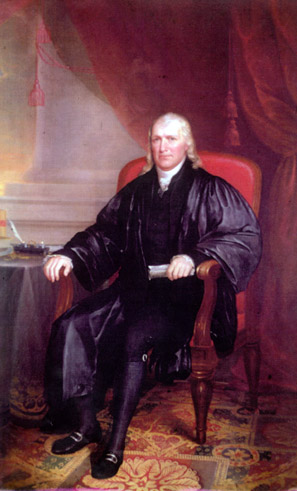
Samuel Chase, 1741-1811
_____________________
Like this:
Like Loading...