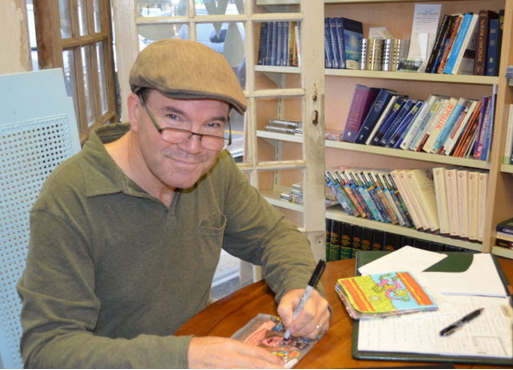
by Marty Coleman | Oct 6, 2009 | William James |
 Effort is a tricky thing. It is very easy to excuse yourself, to talk yourself into believing you have put out quite a bit of effort when you haven’t.
I notice often that people have stock replies to certain situations such as ‘oh, that gives me a headache’ when they don’t really have a headache, they just don’t happen to like a certain sound. Another example is ‘I am completely exhausted’ when in fact they aren’t exhausted, they are just a little tired. Perhaps you have said ‘I have worked all day in the garden’ when actually you worked an hour and a half.
We all know these are just examples of hyperbole or exaggeration. But the danger with exaggeration is you start to believe it is true and you excuse yourself as a result.
You want to achieve something? Be honest about how much effort you are actually putting out. Work hard, keep going, be tenacious, finish strong and go beyond what you expect of yourself when you say those cliche things in your head.
Drawing and commentary © Marty Coleman
“Most people never run far enough on their first wind to find out if they’ve got a second.” – William James, 1842-1910, American Philosopher and Psychologist
Like this:
Like Loading...
by Marty Coleman | Oct 5, 2009 | John Morley |
 When you are tempted to enter a belief system that has a vested interested in a static set of beliefs, a set that cannot change or the system will fall, it is best to consider the choice wisely.
The problem is that theories, evidence, proof and general knowledge of life and the universe is constantly growing and changing. If you are really interested in finding truth and being free to continue to find it over the years, you must in turn be free to go where the evidence leads.
That is problematic if you are in the middle of a belief system that won’t change it’s tenets in the face of evidence, but instead twists the evidence and makes wild and untenable explanations.
drawing and commentary © Marty Coleman
“Where it is a duty to worship the sun it is sure to be a crime to examine the laws of heat.” – John Morley, 1838-1923, British statesman and writer
Like this:
Like Loading...
by Marty Coleman | Oct 4, 2009 | Thornton Wilder |
 A vintage napkin from 2002, drawn for my daughters and put in their school lunches (yes, I drew one for each). The drawing stars Mechanoman and Oreo the Wonderdog.
I am putting it up because one of my dogs, wiggle dog, has lost her voice as a result of the fight she had with stumpy dog. Stumpy dog had a choke hold on her throat and I think it caused a ‘no barking’ thing to happen. She whines really well still.
I don’t always miss the bark, but I do feel bad for wiggle dog not to be able to express herself. I hope she gets better soon.
Drawing © Marty Coleman
Like this:
Like Loading...
by Marty Coleman | Oct 1, 2009 | Mark Twain |
 Our dogs got into a huge fight last night. I heard it as opened my car door after coming from doing a photo shoot. At first I thought it might be one of them having a fight with a raccoon or something. But when they were going at each other like all hell had broken out. I yelled (useless), I kicked (useless) I got a garden utensil and used that to pry them apart. (eventually successful).
But all those things were the WRONG thing to do. They don’t care about you yelling. They don’t feel the pain of a kick right then, too much adrenalin pumping. And a garden utensil, well, it is dangerous!
What I found out later I should have done was take hold of their back legs and pull them away and in a circle. If you don’t have two people to do it to the two dogs at the same time, you should get a leash and put it around the abdomen/hind area of one and pull them away, tying them to a fence or something, then go to the other and do the hind leg technique.
The whole thing made me think. Besides thinking about how stupid I was (and how the dogs suffered more than if they had just kept fighting) I saw how completely and utterly intense they both were. They both were intent on the kill for the most part. it was scary to see. The smaller dog (wiggle dog) was really the aggressor, while stumpy dog was holding on tight! If you extrapolate that behavior to human pursuits, who is going to succeed in them? If you are in a competitive realm, then the amount of fight you have (willingness to pursue your goal, in the face of obstacles and setbacks) is more important that your natural talent and your background and connections. I am talking long-term here, not short-term.
So, don’t bite anyone, and don’t hurt them, but keep the belief and intensity of a fighter who knows they can succeed if they keep at it. Then your size, metaphorically speaking, will not matter all that much.
Drawing and commentary © Marty Coleman
“It’s not the size of the dog in the fight, it’s the size of the fight in the dog.” – Mark Twain, 1835-1910, American Author
Like this:
Like Loading...
by Marty Coleman | Sep 30, 2009 | Harlan Miller |
 30 years ago I married my first wife. She became my unwife 10 years ago. 3 years ago I married my current wife. The reason I mention this is because this quote is both true and not true.
In my first marriage it was probably less true than more. My wife at the time probably should have said more, not less. She hid her feelings and thoughts, either because she didn’t think they were worthy of being paid attention to, or she feared my response. There were other reasons as well, I am sure. I, on the other hand, probably should have said less. I should have listened more and less quickly turned to defending or arguing.
Now I am remarried for 3 years. I have had to relearn some of the same lessons by making the same mistakes, but overall our problems are more in keeping with this quote than not. It might make for a bit more contention at times, but it also makes for a more real marriage. ‘Real’ meaning we see what it is, it isn’t hidden behind a facade or a misleading set of statements. We know where repairs are needed and can work on them. We might ignore the need for the repairs, hoping they take care of themselves, but we eventually come to realize we need to do the repairing. You can’t do that if the actual problem is hidden since you would never know it needed repair in the first place.
The key is to not let those unsaid things stew and simmer and reach a boiling point with a tight lid on. You have to let some of the thoughts out, but you need to discern which ones should be left to die, which ones should be fed, which ones should be ignored. It isn’t an easy process, but in the end the quote is true. Say important things, say them with a loving and caring heart. Don’t say the mean-spirited and petty things, let those die.
Drawing and commentary © Marty Coleman
“Often the difference between a successful marriage and a mediocre one consists of leaving about three or four things a day left unsaid.” – Harlan Miller
Like this:
Like Loading...
by Marty Coleman | Sep 29, 2009 | Death - 2001-2011, Srully Blotnick |
 We woke up this morning to a phone call telling us one of my wife’s employees had been killed in a car wreck. She has to go announce it to her division, make plans for how to respond as a company and as an individual to other individuals.
Sunday we were out furniture shopping when we met a saleswoman. We got into a conversation and learned her daughter had died in a car wreck just short of a year ago. She was just about to turn 15.
One of my recent friends on facebook (I went to high school with her sister and we connected via those FB connections) just recently came upon the 8th anniversary of her son’s death in a car wreck. Less than a month before she had to comfort an old friend whose son had just died in a car wreck.
What do they all have in common? We remain. The loved ones remain. The loved ones grieve. The loved ones suffer terrible loss. Where do we go with it? How do we carry that suitcase of grief? That heavy suitcase with no rollers, no convenient handles, a broken zipper so stuff keeps falling out on the street. That suitcase of grief that pops open at the most inconvenient times.
What do we do with that?
- We get stronger and get some good duct tape and keep carrying it.
- We empty it, put away the contents and put the suitcase back in the closet.
- We tear the suitcase apart and make a sculpture out of it that we place in our backyard and the birds come and sit on it in the sun.
- We give it all away to charity.
- We empty it and take it along our further journey, using it to collect wonderful and redemptive experiences to share with other loved ones and to honor the memory of the lost one.
- We do all those things.
Whatever we do, life still is yours to live. It has fresh peaches in it. It has Kilimanjaro to climb. It is worth living.
drawing and commentary © Marty Coleman
“What looks like a loss may be the very event which is responsible for producing the major achievement of your life,” – Srully Blotnick, 1941-2004, American author and Journalist
Like this:
Like Loading...
by Marty Coleman | Sep 28, 2009 | Anonymous |
 Then again, why not wear plaids and polka dots and guarantee you will meet someone or something completely fun and cool. I am all for clashing nightwear!
Want to help support the Napkin Dad’s creative efforts? In addition to subscribing free at my blog, you can choose to do a paid subscription as well. Your two cents for my two cents. Choose how much you want to subscribe for and you are set for a year. Think of it like an NPR or Public Television fund drive, voluntary but appreciated!
You can pay via PayPal or via Check.
Like this:
Like Loading...
by Marty Coleman | Sep 27, 2009 | Tacitus |
 How odd that two qualities that are admired can lead to ruin. Why is that?
What do they do in excess that makes the giver fall?
Candor is a type of honesty. Too much of that and people rebel against it. People say they like honesty, but what they don’t say is they only like so much of it. Too much can give the people a feeling of getting too close, too familiar.
Generosity is a great thing, but too much of it can make the receiver suspicious, make the community suspicious. It can give the community a feeling of getting too close, too familiar.
Contempt arises, accusations ensue and a downfall begins. Is the giver to blame? Yes, in part. He or she may not have bad motives, may not be doing ‘bad’ things. But they aren’t being discerning, they aren’t being ‘proper’ in their display of both qualities. The results certainly aren’t what they expect, but they could have been expected.
Drawing and commentary © Marty Coleman
“Candor and Generosity, unless tempered by due moderation, lead to ruin.” – Tacitus, 56AD-117AD, Roman Senator and Historian
Like this:
Like Loading...
by Marty Coleman | Sep 26, 2009 | Lord Falkland |
 I love this quote. I can’t remember how many times I have come across someone making a premature decision. There is a compulsion at times to have something figured out before it is necessary. The result is incredible anxiety, bad decisions based on incomplete information without the benefit of unseen future events and defeatist attitude.
drawing © Marty Coleman
“When it is not necessary to make a decision, it is necessary not to make a decision.” – Lord Falkland, 1610-1643, British guy.
Like this:
Like Loading...
by Marty Coleman | Sep 25, 2009 | John Churton Collins, Trust - 2009 |
 I know. This is a creepy image. Ok, so it won’t be a fan favorite. But the drawing fits the idea.
The reason this man shouldn’t be trusted is because he has no discernment. Someone who only says good things about people has not shown they can discern when there is a dangerous, bad person to avoid. I am not talking about dissing someone. I am talking about having a realistic view. If someone looks, walks and talks like a crazed ax murderer, then it is not a bad thing to say so and avoid the person. You aren’t being mean because you are using your mind to keep yourself and others safe.
Could the guy possibly have a nice side? Yea, he could like broadway musicals and long walks on the beach, be nice to dogs and caterpillars and send money to his mom back home every month. But if that is ALL you see of the guy, then you are purposely avoiding reality. He is still a dangerous person and should be avoided.
Obviously, I am talking about extreme circumstances here. The more likely scenario is an everyday friend or relative whose judgment you can’t trust because you haven’t heard anything negative from him or her.
Think of all the American Idol contestants who have to be told by the judges that they aren’t any good at singing, even if their mothers said they were. Their mothers weren’t trustworthy as judges of their ability, they only said good things. They thought they were encouraging, but in fact they were disabling them, making them unable to discern where they were in their singing progress.
Drawing and commentary © Marty Coleman
“Never trust a man who speaks well of everybody.” – John Churton Collins, 1848-1908, British Essayist and Critic
Like this:
Like Loading...

 Effort is a tricky thing. It is very easy to excuse yourself, to talk yourself into believing you have put out quite a bit of effort when you haven’t.