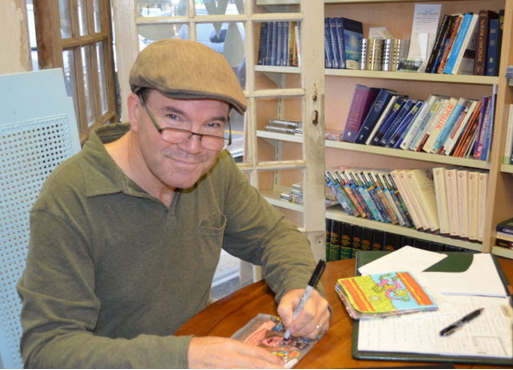
These black and white film portraits were taken in the late 80s and early 90s in and around San Jose, California.
Bob, Eulipia Restaurant, 1990s
He was an aspiring actor and a restauranteur. I took this photo for his actor head shot portfolio in the restaurant he co-owned.
Leslie, San Jose, California, 1990s
I met her through a mutual friend. She wanted some glamorous images of herself before she hit her 30th birthday. I was upstairs in her home changing lens while she went downstairs to get ready for the next set. I happen to see the last bit of sunlight come through a high window and fall on her couch. I quickly directed her to jump on the couch as is and get her face into the light. This is the result less than a minute before the sun sliver disappeared.
Sharon and Carol, Santa Clara County, 1990s
The woman on the left was a customer of mine when I waited tables. We became friends and eventually she hired me to do some family portraits of her and her sister. They were a bit competitive for the spotlight and it was fun to compose and direct them so they both could shine.
Ruth, Santa Cruz, California, 1990s
There is a fantastic beach north of Santa Cruz, California with caves, cliffs and sand in myriad textures and forms. This friend wanted to take some natural portraits in a beautiful light environment and this is the place we chose.
Julie, San Jose, California, 1990s
Sometimes simple and easy does the trick. We were behind a friend’s apartment trying to figure out some photo locations when I spotted her just sitting and waiting for something to happen. It was the best shot of the day.
Lauri, San Jose, California, 1990s
Symmetry can often be pretty boring but in this case the little bit of translucence to the outdoor wall gave enough difference between the sides to make a strong dynamic interplay with her pose.
This is getting to be a habit seeing as it’s Day #4 of Bad Habit Week at the NDD.
My first wife was bothered by my fingers. Not in all circumstances, but when we would be sitting doing something I would have a habit of fidgeting with them I guess, and it bugged the hell out of her. That bad habit magically disappeared when we divorced and she moved out of the house.
What bad habit do you have, or your spouse/family member/roommate have that makes you or them crazy? Was anything every done about it? Make it a habit to leave a comment about habits, ok?
Have you ever found yourself in a situation where you cannot fulfill your habit for an extended period of time? Maybe you went backpacking and couldn’t smoke during the trek. Maybe the power went out and you couldn’t watch TV. Maybe you became unemployed and could no longer shop like you used to.
Sometimes the best thing that can happen to you is an accident of circumstances. Without you planning it you are forced to do without. What is your reaction when this happens? It might make you fidget and pace. It might make you easily irritated. But after a while that habit has less of a hold on you than you realized. You can take that hike without a cigarette. You can live without new shoes every week. You can survive without your favorite reality TV show.
So be open to trying something new, be open to adventure, not for it’s own sake, but for what it forces you to do without. And maybe in the process you will discover that you don’t need that habit after all.
Drawing and commentary by Marty Coleman of The Napkin Dad Daily
Quote by Leo Aikman, 1908-1978, American journalist and speaker
Napkin Dad Trivia – I was blown up in a boat explosion and burned on 70% of my body when I was 18 years old. I spent 7 weeks in the ICU Burn Unit at Kings County Hospital, Brooklyn NY. I consider it one of the most important and positive events of my life. I have awesome scars, you should see them!
The only way I can cope is to present day #2 of Bad Habit week!
Have you ever looked at your habits and thought about when they developed? A good many of them probably started when you were quite young. Why did they develop? One possibility is that they developed to help you cope with something in your life.
Maybe it was your parents’ alcoholism, as in my case. Maybe it was domestic abuse, or being left alone a lot. Perhaps it was an over-controlling or hypercritical parent. As a result you might have made a habit of escape, or defensiveness, or pretending. And maybe those habits served you well, maybe they really did help you cope.
But what about now? Do you still need that habit to cope? Do you still have that parent around you? Are you still bullied at school or under pressure from someone? Or is it now just a habit without a purpose?
If that is the case, maybe you don’t need it any more.
What are the habits you would like to do away with?
Drawing and commentary by Marty Coleman of The Napkin Dad Daily Quote by Johann Wolfgang von Goethe, 1749-1832, German writer
Napkin Dad trivia – I mentioned above about my parents’ alcoholism. My mother spent 3 months at an alcoholic rehab hospital in 1973. She was sober from then on until her death in 1988. My father also quit drinking around the same time (though he sometimes would fall back into it a bit, but never with the same fervor) and is still sober at age 93. I quite drinking in 1993.
I am going to make a habit of this.It’s ‘Bad Habit Week’ at the NDD!
This could easily be called addiction week as well, but I wanted to use the word habit because it applies in more cases. Not everyone is an addict, but everyone has habits. Some can be quite debilitating and destructive so whether we call it an addiction or a habit, it still is a subject that everyone deals with at some level.
The problem with habits is that often times we don’t realize we have them until we get in a relationship. When that happens the other person is close enough often enough to see the habit in action, we can’t hide it. But if we are lucky they are also close enough to say something about it to us. It might be something as simple as leaving the top off the medicine bottle. It might be something as severe as continually hurting someone’s feelings with a facial expression and verbal response.
Even if we are lucky enough to have someone who will point out our bad habits, we still have to decide in our own brain to do something about it. And one thing is for certain, you won’t change a habit by continuing to do the habit. You must adjust. It might be a complete different direction, it might be a slight course change, but whatever it is, you have to decide to do it.
The key is to not be overwhelmed by the task. You don’t have to change your life goal by redefining a new destination, you just have to change take one small step in a new direction. It might be a decision to buy healthier food today at the grocery store. It’s not a decision to ALWAYS and FOREVER ONLY buy healthy food. It’s just a small decision today to buy healthier food. Do that one thing and you have changed your direction and that is enough. Worry about the next trip to the store when you take it, not today.
Drawing and commentary by Marty Coleman
Quote is a Chinese proverb
Napkin Dad Trivia – I learned to fly airplanes when I was 13 years old.
I took a LOT of slides back in the 80s. My then father-in-law was a big slide film fan and I became one as a result. I recently decided to experiment with scanning these old slides on my flat bed scanner. The results are evocative and mysterious.
Since it’s such a hot summer I thought I would post a selection of summer photos from that era.
Diver, Almaden Swim and Racquet Club, San Jose, California, 1980sSwimmer, Almaden Swim and Racquet Club, San Jose, California, 1980sDigging, Santa Cruz, California, 1980sFlip, Almaden Swim and Racquet Club, San Jose, California, 1980sSunbather, San Jose, California, 1980s
Alas, we have reached the end of ‘The Gospel According to Harry Potter’ Week.
In the first book, Harry finds a mirror that allows him to see his now dead parents looking down on him. He is comforted and sits in front of the mirror for lengthy stays again and again. Finally Headmaster Dumbledore comes to Harry and encourages him to move forward in life with the above quote.
In the New Testament dreams play a major role in moving Joseph, the father of Jesus, to take action. He first is told in a dream to not worry about the consequences of marrying Mary after she has proclaimed she is pregnant. After Jesus is born he is again told in a dream that his family is in danger and he needs to leave the country and go to Egypt. In both cases he obeys the dream’s directive.
Harry was stuck in a dream of ‘what if’ and Dumbledore had to gently coax him out of it into his real life. Joseph, on the other hand, was in a different type of dream, a dream encouraging action. He had to decide to obey the dreams or not.
That is the key after all, isn’t it? Dreams, especially dreams of what you want to have happen in life, aren’t really of much use unless you act on them and make them real.
Life doesn’t happen in dreams, life is only imagined in them.
Drawing and commentary @ 2026 by Marty Coleman of The Napkin Dad Daily
Quote by J.K. Rowling, British author, 1965 – not dead yet. Quote spoken by Albus Dumbledore in ‘Harry Potter and the Sorcerer’s Stone’.
Some interesting notes on the writing of Harry Potter:
You probably know that J.K. Rowling thought of the idea for the books while on a train trip. But did you know she did not have a pen with her? She was too shy to ask anyone to borrow one so she sat and thought the entire story out in her mind for 4 hours before getting off the train and getting to a location where she could get a pen and start writing it down.
You probably know that the much of the story was figured out before she started writing the first book. But did you know she actually wrote the last chapter of the entire series at the time she wrote the first book?
You probably know the manuscript was rejected by many publishers. But did you know it took 7 full years from the inception of the idea on the train until the actual publication of the book?
I am not draggin’ even if it is day #4 of The Gospel According to Harry Potter!
In ‘Harry Potter and the Goblet of Fire’ Ron asks a rhetorical question at the end of the school year. It’s been a crazy year with death, mayhem, and yes, dragons. He asks, “Do you think we will ever have a quiet year at Hogwarts?” Hermoine replies, “No” to which Ron responds with the above quote.
I was thinking of drawing a scary dragon but I have seen a trend in the story that made me draw a friendly one. What I saw was Harry and his friends constantly being confronted with what looks like an enemy only to find that that enemy is, or could be, a friend. It isn’t true with everyone, but between a villain who turns out to be a godfather (a good godfather, not the mafia type), a giant that turns out to be gentle and creepy skeleton type winged horses that are very helpful we have many examples of an enemy turning into a friend.
Jesus teaches the underlying lesson and it’s quite simple. It’s not enough to love your friends, you must endeavor to love your enemies as well. How does this relate? You can’t love someone or something without getting to know them. Loving from a distance isn’t really love. That only happens when you get up close and personal enough to find what there is to love about the person or thing. It means you forego judgment and take the time to find out what is truly there.
Abraham Lincoln had a great response about this same idea. He said, “Am I not destroying an enemy when I make them my friend?”
Drawing and commentary by Marty Coleman of The Napkin Dad Daily
Quote by J.K. Rowling, 1965-not dead yet, British author. Spoken by the character Ron Weasley.
I have a question for the Napkin Kin who look closely at the drawings and like seeing new things. There is something about this drawing that is unique. It’s not about the content, just about a small something I did a bit differently than usual in this drawing. Can you see what it is?
“All things are lawful, but not all things edify.”When Harry Potter looks into the Pensieve in ‘The Goblet of Fire’ he isn’t at all aware of it’s danger. He simply sees this glowing thing while alone in Dumbledore’s office and goes to take a look. It turns out to be a memory machine of sorts, a way for Dumbledore to remember what has happened and what Potter sees in it is important for the story. Dumbledore’s admonition about curiosity isn’t all that convincing in that specific instance but as a general rule it has it’s wisdom.
In the New Testament Paul of Tarsus writes something similar, but within a different context. He is dealing with a group of people who have been freed from a very restrictive set of laws and rules about what is and is not a sin. They are free. But now they need to learn a new way of judging what is good or bad. It can no longer be based on outside rules, it has to be based on something closer to home, more personal. Paul clarifies what that is in this passage from his first letter to the followers in the city of Corinth:
In other words, yes, you are free to pursue what peaks your curiosity. But beware, just because you are curious about it doesn’t mean it’s the best thing to investigate. Investigate your own motives and the potential risks before you perhaps fall headlong into a hole.
Drawing and commentary by Marty Coleman of The Napkin Dad Daily Quote by J. K. Rowling, 1965- not dead yet, British author. Spoken by Albus Dumbledore in book #4, Harry Potter and The Goblet of Fire.
I swear on the Bible it’s day #2 of‘The Gospel According to Harry Potter’ week!
One of the hardest things to accept is that we can plan the future in great detail and still have no guarantee it will turn out according to our plans. There are too many overlapping elements of cause and effect taking place for precise predictions to be very accurate.
J. K. Rowling’s story is a good example of that. When she started the first book of the Harry Potter series she had a pretty good idea of the overarching storyline. But then her mother died unexpectedly at age 45. That single unpredicted event caused her to heavily refocus the story to have Harry more emotionally in turmoil over the death of his own parents.
One of the strongest elements of the Harry Potter series is the realistic depiction of what a young person goes through when everything they hold dear is taken away. It allows many who read the books to relate to Harry in a way they otherwise might not have. We can’t say for certain, but it’s very possible that one element was critical in the huge audience response, and IT could not have been predicted. Jesus addresses this same issue when he talks about the uselessness of worry, especially about the future. He knows that it’s impossible to control the future (and the past) so in his mind it is much better to think about what you can and should do in the here and now, to solve today’s problems.
Read Matthew 6 in the New Testament for the specific teaching. The chapter ends with ‘Therefore do not worry about tomorrow, for tomorrow will worry about itself. Each day has enough trouble of its own.’
Drawing and commentary by Marty Coleman of The Napkin Dad Daily
Quote by J.K. Rowling, 1965-not dead yet, British author. Quote is spoken by Albus Dumbledore in book #3 – Harry Potter and the Prisoner of Azkaban